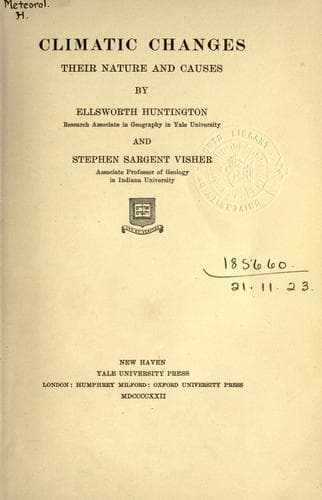
Climatic Changes: Their Nature and CausesHuntington, Ellsworth
Science
Climatic Changes: Their Nature and Causes
Huntington, Ellsworth
Climatic changes; Climatology; Paleoclimatology
(3) Among the indirect effects of salinity one of the chief appears to
be that the low salinity of the water in the past and the greater ease
with which it froze presumably allowed the temperature of the entire
ocean to be slightly higher than now. This is because ice serves as a
blanket and hinders the radiation of heat from the underlying water. The
temperature of the ocean has a climatic significance not only directly,
but indirectly through its influence on the amount of carbon dioxide
held by the oceans. A change of even 1 deg.C. from the present mean
temperature of 2 deg.C. would alter the ability of the entire ocean to
absorb carbon dioxide by about 4 per cent. This, according to F. W.
Clarke,[99] is because the oceans contain from eighteen to twenty-seven
times as much carbon dioxide as the air when only the free carbon
dioxide is considered, and about seventy times as much according to
Johnson and Williamson[100] when the partially combined carbon dioxide
is also considered. Moreover, the capacity of water for carbon dioxide
varies sharply with the temperature.[101] Hence a rise in temperature of
only 1 deg.C. would theoretically cause the oceans to give up from 30 to 280
times as much carbon dioxide as the air now holds. This, however, is on
the unfounded assumption that the oceans are completely saturated. The
important point is merely that a slight change in ocean temperature
would cause a disproportionately large change in the amount of carbon
dioxide in the air with all that this implies in respect to blanketing
the earth, and thus altering temperature.
(4) Another and perhaps the most important effect of salinity upon
climate depends upon the rapidity of the deep-sea circulation. The
circulation is induced by differences of temperature, but its speed is
affected at least slightly by salinity. The vertical circulation is now
dominated by cold water from subpolar latitudes. Except in closed seas
like the Mediterranean the lower portions of the ocean are near the
freezing point. This is because cold water sinks in high latitudes by
reason of its superior density, and then "creeps" to low latitudes.
There it finally rises and replaces either the water driven poleward by
the winds, or that which has evaporated from the Surface.[102]
Public-domain text, read in full here on John Shaqi.
Reviews
Reviews
No reviews yet
Be the first to share your thoughts on this work.
Elsewhere in the archive
Join the Discussion
Join the discussion
Sign in to leave a comment or review.
Sign InorCreate an account