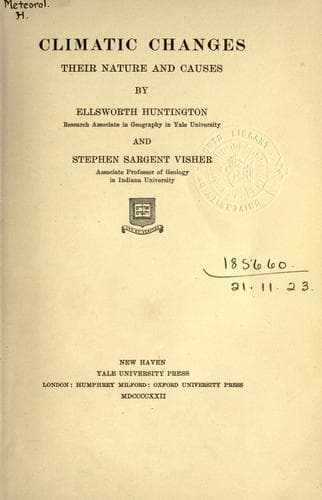
Climatic Changes: Their Nature and CausesHuntington, Ellsworth
Science
Climatic Changes: Their Nature and Causes
Huntington, Ellsworth
Climatic changes; Climatology; Paleoclimatology
standpoint, since so few fossils have been recovered, but what is at
hand suggests that the marine environment was similar to that of today."
At present, as we have repeatedly seen, little growth takes place either
among animals or plants at temperatures below 0 deg.C. or above 40 deg.C., and
for most species the limiting temperatures are about 10 deg. and 30 deg.. The
maintenance of so narrow a scale of temperature is a function of the
atmosphere, as well as of the sun. Without an atmosphere, the
temperature by day would mount fatally wherever the sun rides high in
the sky. By night it would fall everywhere to a temperature approaching
absolute zero, that is -273 deg.C. Some such temperature prevails a few
miles above the earth's surface, beyond the effective atmosphere.
Indeed, even if the atmosphere were almost as it is now, but only lacked
one of the minor constituents, a constituent which is often actually
ignored in statements of the composition of the air, life would be
impossible. Tyndall concludes that if water vapor were entirely removed
from the atmosphere for a single day and night, all life--except that
which is dormant in the form of seeds, eggs, or spores--would be
exterminated. Part would be killed by the high temperature developed by
day when the sun was high, and part, by the cold night.
The testimony of ancient glaciation as to the slight difference in the
climate and therefore in the atmosphere of early and late geological
times is almost as clear as that of life. Just as life proves that the
earth can never have been extremely cold during hundreds of millions of
years, so glaciation in moderately low latitudes near the dawn of earth
history and at several later times, proves that the earth was not
particularly hot even in those early days. The gentle progressive change
of climate which is recorded in the rocks appears to have been only in
slight measure a change in the mean temperature of the earth as a whole,
and almost entirely a change in the distribution of temperature from
place to place and season to season. Hence it seems probable that
neither the earth's own emission of heat, nor the supply of solar heat,
nor the power of the atmosphere to retain heat can have been much
greater a few hundred million years ago than now. It is indeed possible
that these three factors may have varied in such a way that any
variation in one has been offset by variations of the others in the
opposite direction. This, however, is so highly improbable that it seems
advisable to assume that all three have remained relatively constant.
This conclusion together with a realization of the climatic significance
of carbon dioxide has forced most of the adherents of the nebular
hypothesis to abandon their assumption that carbon dioxide, the heaviest
gas in the air, was very abundant until taken out by coal-forming plants
or combined with the calcium oxide of igneous rocks to form the
limestone secreted by animals.
Public-domain text, read in full here on John Shaqi.
Reviews
Reviews
No reviews yet
Be the first to share your thoughts on this work.
Elsewhere in the archive
Join the Discussion
Join the discussion
Sign in to leave a comment or review.
Sign InorCreate an account