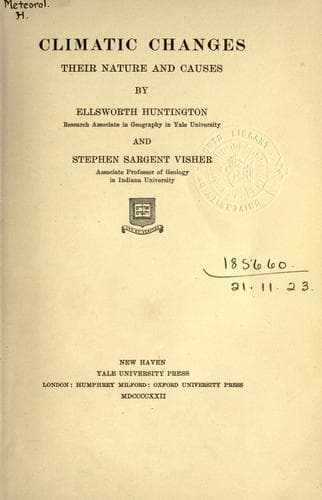
Climatic Changes: Their Nature and CausesHuntington, Ellsworth
Science
Climatic Changes: Their Nature and Causes
Huntington, Ellsworth
Climatic changes; Climatology; Paleoclimatology
In the same way the presence of sun
cracks in sedimentary rocks of all ages suggests that the air cannot
have contained vast quantities of water vapor such as have been assumed
by Knowlton and others in order to account for the former lack of sharp
climatic contrast between the zones. Such a large amount of water vapor
would almost certainly be accompanied by well-nigh universal and
continual cloudiness so that there would be little chance for the pools
on the earth's water-soaked surface to dry up. Furthermore, there is
only one way in which such cloudiness could be maintained and that is by
keeping the air at an almost constant temperature night and day. This
would require that the chief source of warmth be the interior of the
earth, a condition which the Proterozoic, Permian, and other widespread
glaciations seem to disprove.
Thus there appears to be strong evidence against the radical changes in
the atmosphere which are sometimes postulated. Yet some changes must
have taken place, and even minor changes would be accompanied by some
sort of climatic effect. The changes would take the form of either an
increase or a decrease in the atmosphere as a whole, or in its
constituent elements. The chief means by which the atmosphere has
increased appear to be as follows: (a) By contributions from the
interior of the earth via volcanoes and springs and by the weathering of
igneous rocks with the consequent release of their enclosed gases;[106]
(b) by the escape of some of the abundant gases which the ocean holds in
solution; (c) by the arrival on the earth of gases from space, either
enclosed in meteors or as free-flying molecules; (d) by the release of
gases from organic compounds by oxidation, or by exhalation from animals
and plants. On the other hand, one or another of the constituents of the
atmosphere has presumably decreased (a) by being locked up in newly
formed rocks or organic compounds; (b) by being dissolved in the ocean;
(c) by the escape of molecules into space; and (d) by the condensation
of water vapor.
Public-domain text, read in full here on John Shaqi.
Reviews
Reviews
No reviews yet
Be the first to share your thoughts on this work.
Elsewhere in the archive
Join the Discussion
Join the discussion
Sign in to leave a comment or review.
Sign InorCreate an account