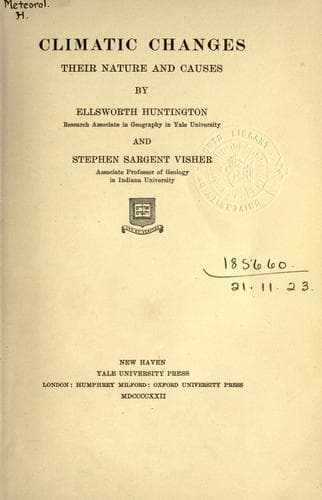
Climatic Changes: Their Nature and CausesHuntington, Ellsworth
Science
Climatic Changes: Their Nature and Causes
Huntington, Ellsworth
Climatic changes; Climatology; Paleoclimatology
Our use of Jeans' data interposes another and equally insuperable
difficulty to any tidal hypothesis. Four billion miles is a very short
distance in the eyes of an astronomer. At that distance a star twice the
size of the sun would attract the outer planets more strongly than the
sun itself, and might capture them. If a star should come within four
billion miles of the sun, its effect in distorting the orbits of all the
planets would be great. If this had happened often enough to cause all
the glaciations known to geologists, the planetary orbits would be
strongly elliptical instead of almost circular. The consideration here
advanced militate so strongly against the tidal hypothesis of solar
disturbances that it seems scarcely worth while to consider it further.
Let us turn now to the electrical hypothesis. Here the conditions are
fundamentally different from those of the tidal hypothesis. In the first
place the electrostatic effect of a body has nothing to do with its
mass, but depends on the area of its surface; that is, it varies as the
square of the radius. Second, the emission of electrons varies
exponentially. If hot glowing stars follow the same law as black bodies
at lower temperatures, the emission of electrons, like the emission of
other kinds of energy, varies as the fourth power of the absolute
temperature. In other words, suppose there are two black bodies,
otherwise alike, but one with a temperature of 27 deg. C. or 300 deg. on the
absolute scale, and the other with 600 deg. on the absolute scale. The
temperature of one is twice as high as that of the other, but the
electrostatic effect will be sixteen times as great.[115] Third, the
number of electrons that reach a given body varies inversely as the
square of the distance, instead of as the cube which is the case with
tide-making forces.
In order to use these three principles in calculating the effect of the
stars we must know the diameters, distances, temperature, and number of
the stars. The distances and number may safely be taken as given by
Jeans in the calculations already cited. As to the diameters, the
measurements of the stars thus far made indicate that the average mass
is about twice that of the sun. The average density, as deduced by
Shapley[116] from the movements of double stars, is about one-eighth the
solar density. This would give an average diameter about two and a half
times that of the sun. For the dark stars, we shall assume for
convenience that they are ten times as numerous as the bright ones. We
shall also assume that their diameter is half that of the sun, for being
cool they must be relatively dense, and that their temperature is the
same as that which we shall assume for Jupiter.
Public-domain text, read in full here on John Shaqi.
Reviews
Reviews
No reviews yet
Be the first to share your thoughts on this work.
Elsewhere in the archive
Join the Discussion
Join the discussion
Sign in to leave a comment or review.
Sign InorCreate an account