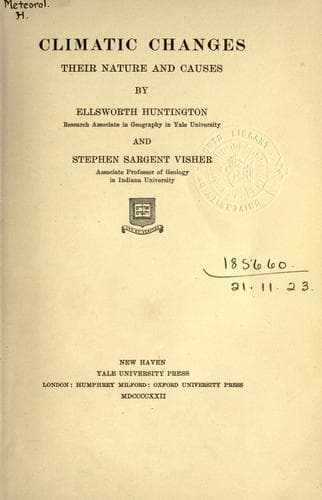
Climatic Changes: Their Nature and CausesHuntington, Ellsworth
Science
Climatic Changes: Their Nature and Causes
Huntington, Ellsworth
Climatic changes; Climatology; Paleoclimatology
On the basis of this assumption our first problem is to estimate the
frequency with which a star, visible or dark, is likely to approach near
enough to the sun to produce a _tidal_ effect four times that of
Jupiter. The number of visible stars is known or at least well
estimated. As to dark stars, which have grown cool, Arrhenius believed
that they are a hundred times as numerous as bright stars; few
astronomers believe that there are less than three or four times as
many. Dr. Shapley of the Harvard Observatory states that a new
investigation of the matter suggests that eight or ten is probably a
maximum figure. Let us assume that nine is correct. The average visible
star, so far as measured, has a mass about twice that of the sun, or
about 2100 times that of Jupiter. The distances of the stars have been
measured in hundreds of cases and thus we can estimate how many stars,
both visible and invisible, are on an average contained in a given
volume of space. On this basis Jeans estimates that there is only one
chance in thirty billion years that a visible star will approach within
2.8 times the distance of Neptune from the sun, that is, within about
eight billion miles. If we include the invisible stars the chances
become one in three billion years. In order to produce four times the
tidal effect of Jupiter, however, the average star would have to
approach within about four billion miles of the sun, and the chances of
that are only one in twelve billion years. The disturbing star would be
only 40 per cent farther from the sun than Neptune, and would almost
pass within the solar system.
Even though Jeans holds that the frequency of the mutual approach of the
sun and a star was probably much greater in the distant past than at
present, the figures just given lend little support to the tidal
hypothesis. In fact, they apparently throw it out of court. It will be
remembered that Jeans has made assumptions which give as high a
frequency of stellar encounters as is consistent with the astronomical
facts. We have assumed nine dark stars for every bright one, which may
be a liberal estimate. Also, although we have assumed that a disturbance
of the sun's atmosphere sufficient to cause a glacial period would arise
from a tidal effect only twenty times as great as the difference in
Jupiter's effect when nearest the sun and farthest away, in our
computations this has actually been reduced to thirteen. With all these
favorable assumptions the chances of a stellar approach of the sort here
described are now only one in twelve billion years. Yet within a hundred
million years, according to many estimates of geological time, and
almost certainly within a billion, there have been at least half a dozen
glaciations.
Public-domain text, read in full here on John Shaqi.
Reviews
Reviews
No reviews yet
Be the first to share your thoughts on this work.
Elsewhere in the archive
Join the Discussion
Join the discussion
Sign in to leave a comment or review.
Sign InorCreate an account