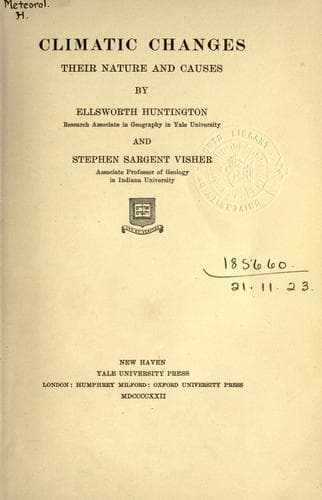
Climatic Changes: Their Nature and CausesHuntington, Ellsworth
Science
Climatic Changes: Their Nature and Causes
Huntington, Ellsworth
Climatic changes; Climatology; Paleoclimatology
Thus far in our attempt to estimate the distance at which a star might
disturb the sun enough to cause glaciation on the earth, we have
considered only the star's size and temperature. No account has been
taken of the degree to which its atmosphere is disturbed. Yet in the
case of the sun this seems to be one of the most important factors. The
magnetic field of sunspots is sometimes 50 or 100 times as strong as
that of the sun in general. The strength of the magnetic field appears
to depend on the strength of the electrical currents in the solar
atmosphere. But the intensity of the sunspots and, by inference, of the
electrical currents, may depend on the electrical action of Jupiter and
the other planets. If we apply a similar line of reasoning to the stars,
we are at once led to question whether the electrical activity of double
stars may not be enormously greater than that of isolated stars like the
sun.
If this line of reasoning is correct, the atmosphere of every double
star must be in a state of commotion vastly greater than that of the
sun's atmosphere even when it is most disturbed. For example, suppose
the sun were accompanied by a companion of equal size at a distance of
one million miles, which would make it much like many known double
stars. Suppose also that in accordance with the general laws of physics
the electrical effect of the two suns upon one another is proportional
to the fourth power of the temperature, the square of the radius, and
the inverse square of the distance. Then the effect of each sun upon the
other would be sixty billion (6 x 10^{10}) times as great as the present
electrical effect of Jupiter upon the sun. Just what this would mean as
to the net effect of a pair of such suns upon the electrical potential
of other bodies at a distance we can only conjecture. The outstanding
fact is that the electrical conditions of a double star must be
radically different and vastly more intense than those of a single star
like the sun.
Public-domain text, read in full here on John Shaqi.
Reviews
Reviews
No reviews yet
Be the first to share your thoughts on this work.
Elsewhere in the archive
Join the Discussion
Join the discussion
Sign in to leave a comment or review.
Sign InorCreate an account