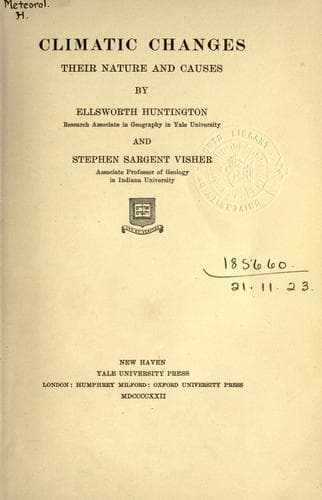
Climatic Changes: Their Nature and CausesHuntington, Ellsworth
Science
Climatic Changes: Their Nature and Causes
Huntington, Ellsworth
Climatic changes; Climatology; Paleoclimatology
This conclusion carries weighty consequences. At present twenty or more
stars are known to be located within about 100 trillion miles of the sun
(five parsecs, as the astronomers say), or 16.5 light years. According
to the assumptions employed in Table 5 an average single star would
influence the sun enough to cause glaciation if it came within
approximately 200 billion miles. If the star were double, however, it
might have an electrical capacity enormously greater than that of the
sun. Then it would be able to cause glaciation at a correspondingly
great distance. Today Alpha Centauri, the nearest known star about
twenty-five trillion miles, or 4.3 light years from the sun, and Sirius,
the brightest star in the heavens, is about fifty trillion miles away,
or 8.5 light years. If these stars were single and had a diameter three
times that of the sun, and if they were of the same temperature as has
been assumed for Betelgeuse, which is about fifty times as far away as
Alpha Centauri, the relative effects of the three stars upon the sun
would be, approximately, Betelgeuse 700, Alpha Centauri 250, Sirius 1.
But Alpha Centauri is triple and Sirius double, and both are much hotter
than Betelgeuse. Hence Alpha Centauri and even Sirius may be far more
effective than Betelgeuse.
The two main components of Alpha Centauri are separated by an average
distance of about 2,200,000,000 miles, or somewhat less than that of
Neptune from the sun. A third and far fainter star, one of the faintest
yet measured, revolves around them at a great distance. In mass and
brightness the two main components are about like the sun, and we will
assume that the same is true of their radius. Then, according to the
assumptions made above, their effect in disturbing one another
electrically would be about 10,000 times the total effect of Jupiter
upon the sun, or 2500 times the effect that we have assumed to be
necessary to produce a glacial period. We have already seen in Table 5
that, according to our assumptions, a single star like the sun would
have to approach within 120 billion miles of the solar system, or within
2 per cent of a light year, in order to cause glaciation. By a similar
process of reasoning it appears that if the mutual electrical excitation
of the two main parts of Alpha Centauri, regardless of the third part,
is proportional to the apparent excitation of the sun by Jupiter, Alpha
Centauri would be 5000 times as effective as the sun. In other words, if
it came within 8,500,000,000,000 miles of the sun, or 1.4 light years,
it would so change the electrical conditions as to produce a glacial
epoch. In that case Alpha Centauri is now so near that it introduces a
disturbing effect equal to about one-sixth of the effect needed to cause
glaciation on the earth. Sirius and perhaps others of the nearer and
brighter or larger stars may also create appreciable disturbances in the
electrical condition of the sun's atmosphere, and may have done so to a
Public-domain text, read in full here on John Shaqi.
Reviews
Reviews
No reviews yet
Be the first to share your thoughts on this work.
Elsewhere in the archive
Join the Discussion
Join the discussion
Sign in to leave a comment or review.
Sign InorCreate an account