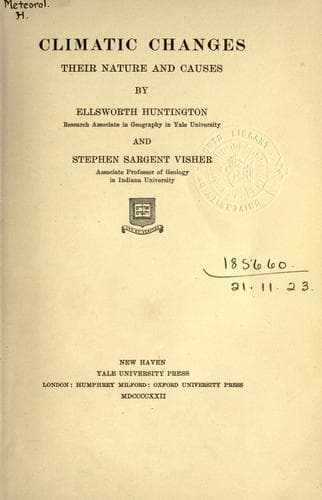
Climatic Changes: Their Nature and CausesHuntington, Ellsworth
Science
Climatic Changes: Their Nature and Causes
Huntington, Ellsworth
Climatic changes; Climatology; Paleoclimatology
The present volume is the fifth work published by the Yale
University Press on the Theodore L. Glasgow Memorial Publication
Fund. This foundation was established September 17, 1918, by an
anonymous gift to Yale University in memory of Flight Sub-Lieutenant
Theodore L. Glasgow, R.N. He was born in Montreal, Canada, and was
educated at the University of Toronto Schools and at the Royal
Military College, Kingston. In August, 1916, he entered the Royal
Naval Air Service and in July, 1917, went to France with the Tenth
Squadron attached to the Twenty-second Wing of the Royal Flying
Corps. A month later, August 19, 1917, he was killed in action on
the Ypres front.
TO
THOMAS CHROWDER CHAMBERLIN
OF THE UNIVERSITY OF CHICAGO
WHOSE CLEAR AND MASTERLY DISCUSSION OF THE GREAT PROBLEMS
OF TERRESTRIAL EVOLUTION HAS BEEN ONE OF THE MOST INSPIRING
FACTORS IN THE WRITING OF THIS BOOK
_There is a toy, which I have heard, and I would not have it given
over, but waited upon a little. They say it is observed in the Low
Countries (I know not in what part), that every five and thirty
years the same kind and suit of years and weathers comes about
again; as great frosts, great wet, great droughts, warm winters,
summers with little heat, and the like, and they call it the prime;
it is a thing I do the rather mention, because, computing backwards,
I have found some concurrence._
FRANCIS BACON
PREFACE
Unity is perhaps the keynote of modern science. This means unity in
time, for the present is but the outgrowth of the past, and the future
of the present. It means unity of process, for there seems to be no
sharp dividing line between organic and inorganic, physical and mental,
mental and spiritual. And the unity of modern science means also a
growing tendency toward cooeperation, so that by working together
scientists discover much that would else have remained hid.
This book illustrates the modern trend toward unity in all of these
ways. First, it is a companion volume to _Earth and Sun_. That volume is
a discussion of the causes of weather, but a consideration of the
weather of the present almost inevitably leads to a study of the climate
of the past. Hence the two books were written originally as one, and
were only separated from considerations of convenience. Second, the
unity of nature is so great that when a subject such as climatic changes
is considered, it is almost impossible to avoid other subjects, such as
the movements of the earth's crust. Hence this book not only discusses
climatic changes, but considers the causes of earthquakes and attempts
to show how climatic changes may be related to great geological
revolutions in the form, location, and altitude of the lands. Thus the
book has a direct bearing on all the main physical factors which have
molded the evolution of organic life, including man.
Public-domain text, read in full here on John Shaqi.
Reviews
Reviews
No reviews yet
Be the first to share your thoughts on this work.
Join the Discussion
Join the discussion
Sign in to leave a comment or review.
Sign InorCreate an account