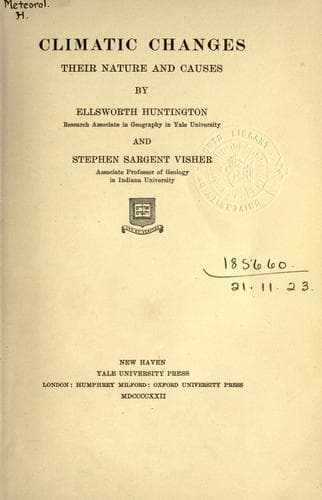
Climatic Changes: Their Nature and CausesHuntington, Ellsworth
Science
Climatic Changes: Their Nature and Causes
Huntington, Ellsworth
Climatic changes; Climatology; Paleoclimatology
If the electro-stellar hypothesis of solar disturbances proves well
founded, it may explain these peculiarities. Periods of mild climate
would represent a return of the sun and the earth to their normal
conditions of quiet. At such times the atmosphere of the sun is assumed
to be little disturbed by sunspots, faculae, prominences, and other
allied evidences of movements; and the rice-grain structure is perhaps
the most prominent of the solar markings. The earth at such times is
supposed to be correspondingly free from cyclonic storms. Its winds are
then largely of the purely planetary type, such as trade winds and
westerlies. Its rainfall also is largely planetary rather than cyclonic.
It falls in places such as the heat equator where the air rises under
the influence of heat, or on the windward slopes of mountains, or in
regions where warm winds blow from the ocean over cold lands.
According to the electro-stellar hypothesis, the conditions which
prevailed during hundreds of millions of years of mild climate mean
merely that the solar system was then in parts of the heavens where
stars--especially double stars--were rare or small, and electrical
disturbances correspondingly weak. Today, on the other hand, the sun is
fairly near a number of stars, many of which are large doubles. Hence it
is supposed to be disturbed, although not so much as at the height of
the last glacial epoch.
After the preceding parts of this book had been written, the assistance
of Dr. Schlesinger made it possible to test the electro-stellar
hypothesis by comparing actual astronomical dates with the dates of
climatic or solar phenomena. In order to make this possible, Dr.
Schlesinger and his assistants have prepared Table 6, giving the
position, magnitude, and motions of the thirty-eight nearest stars, and
especially the date at which each was nearest the sun. In column 10
where the dates are given, a minus sign indicates the past and a plus
sign the future. Dr. Shapley has kindly added column 12, giving the
absolute magnitudes of the stars, that of the sun being 4.8, and column
13, showing their luminosity or absolute radiation, that of the sun
being unity. Finally, column 14 shows the effective radiation received
by the sun from each star when the star is at a minimum distance. Unity
in this case is the effect of a star like the sun at a distance of one
light year.
Public-domain text, read in full here on John Shaqi.
Reviews
Reviews
No reviews yet
Be the first to share your thoughts on this work.
Elsewhere in the archive
Join the Discussion
Join the discussion
Sign in to leave a comment or review.
Sign InorCreate an account