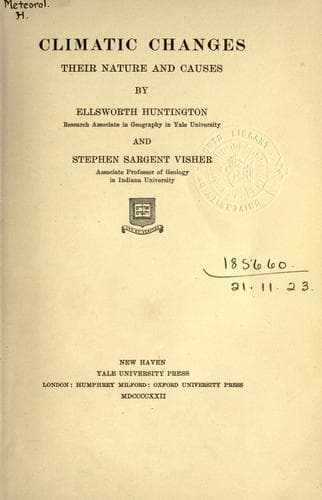
Climatic Changes: Their Nature and CausesHuntington, Ellsworth
Science
Climatic Changes: Their Nature and Causes
Huntington, Ellsworth
Climatic changes; Climatology; Paleoclimatology
Not only are fully a third of all the visible stars double, as we have
already seen, but at least a tenth of these are known to be triple or
multiple. In many of the double stars the two bodies are close together
and revolve so rapidly that whatever periodicity they might create in
the sun's atmosphere would be very short. In the triplets, however, the
third star is ordinarily at least ten times as far from the other two as
they are from each other, and its period of rotation sometimes runs into
hundreds or thousands of years. An actual multiple star in the
constellation Polaris will serve as an example. The main star is
believed by Jeans to consist of two parts which are almost in contact
and whirl around each other with extraordinary speed in four days. If
this is true they must keep each other's atmospheres in a state of
intense commotion. Much farther away a third star revolves around this
pair in twelve years. At a much greater distance a fourth star revolves
around the common center of gravity of itself and the other three in a
period which may be 20,000 years. Still more complicated cases probably
exist. Suppose such a system were to traverse a path where it would
exert a perceptible influence on the sun for thirty or forty thousand
years. The varying movements of its members would produce an intricate
series of cycles which might show all sorts of major and minor
variations in length and intensity. Thus the varied and irregular stages
of glaciation and the pulsations of historic times might be accounted
for on the hypothesis of the proximity of the sun to a multiple star, as
well as on that of the less pronounced approach and recession of a
number of stars. In addition to all this, an almost infinitely complex
series of climatic changes of long and short duration might arise if the
sun passed through a nebula.
5. We have seen in Chapter VIII that the contrast between the somewhat
severe climate of the present and the generally mild climate of the past
is one of the great geological problems. The glacial period is not a
thing of the distant past. Geologists generally recognize that it is
still with us. Greenland and Antarctica are both shrouded in ice sheets
in latitudes where fossil floras prove that at other periods the climate
was as mild as in England or even New Zealand. The present glaciated
regions, be it noted, are on the polar borders of the world's two most
stormy oceanic areas, just where ice would be expected to last longest
according to the solar cyclonic hypothesis. In contrast with the
semi-glacial conditions of the present, the last inter-glacial epoch was
so mild that not only men but elephants and hippopotamuses flourished in
central Europe, while at earlier times in the middle of long eras, such
as the Paleozoic and Mesozoic, corals, cycads, and tree ferns flourished
within the Arctic circle.
Public-domain text, read in full here on John Shaqi.
Reviews
Reviews
No reviews yet
Be the first to share your thoughts on this work.
Elsewhere in the archive
Join the Discussion
Join the discussion
Sign in to leave a comment or review.
Sign InorCreate an account