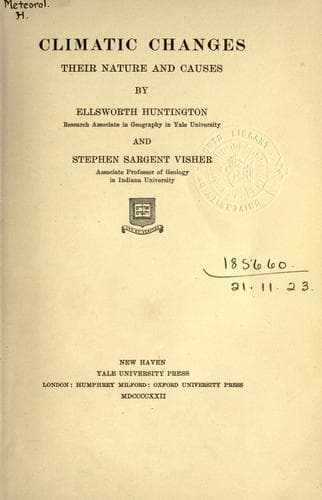
Climatic Changes: Their Nature and CausesHuntington, Ellsworth
Science
Climatic Changes: Their Nature and Causes
Huntington, Ellsworth
Climatic changes; Climatology; Paleoclimatology
According to the electro-stellar hypothesis, Alpha Centauri is more
important climatically than any other star in the heavens not only
because it is triple and bright, but because it is the nearest of all
stars, and moves fairly rapidly. Sirius and Procyon move slowly in
respect to the sun, only about eleven and eight kilometers per second
respectively, and their distances at minimum are fairly large, that is,
8 and 10.2 light years. Hence their effect on the sun changes slowly.
Altair moves faster, about twenty-six kilometers per second, and its
minimum distance is 6.4 light years, so that its effect changes fairly
rapidly. Alpha Centauri moves about twenty-four kilometers per second,
and its minimum distance is only 3.2 light years. Hence its effect
changes very rapidly, the change in its apparent luminosity as seen from
the sun amounting at maximum to about 30 per cent in 10,000 years
against 14 per cent for Altair, 4 for Sirius, and 2 for Procyon. The
vast majority of the stars change so much more slowly than even Procyon
that their effect is almost uniform. All the stars at a distance of more
than perhaps twenty or thirty light years may be regarded as sending to
the sun a practically unchanging amount of radiation. It is the bright
stars within this limit which are important, and their importance
increases with their proximity, their speed of motion, and the
brightness and number of their companions. Hence Alpha Centauri causes
the main maximum in Fig. 10, while Sirius, Altair, and Procyon combine
to cause a general rise of the curve from the past to the future.
Let us now interpret Fig. 10 geologically. The low position of the curve
fifty to seventy thousand years ago suggests a mild inter-glacial
climate distinctly less severe than that of the present. Geologists say
that such was the case. The curve suggests a glacial epoch culminating
about 28,000 years ago. The best authorities put the climax of the last
glacial epoch between twenty-five and thirty thousand years ago. The
curve shows an amelioration of climate since that time, although it
suggests that there is still considerable severity. The retreat of the
ice from North America and Europe, and its persistence in Greenland and
Antarctica agree with this. And the curve indicates that the change of
climate is still persisting, a conclusion in harmony with the evidence
as to historic changes.
Public-domain text, read in full here on John Shaqi.
Reviews
Reviews
No reviews yet
Be the first to share your thoughts on this work.
Elsewhere in the archive
Join the Discussion
Join the discussion
Sign in to leave a comment or review.
Sign InorCreate an account