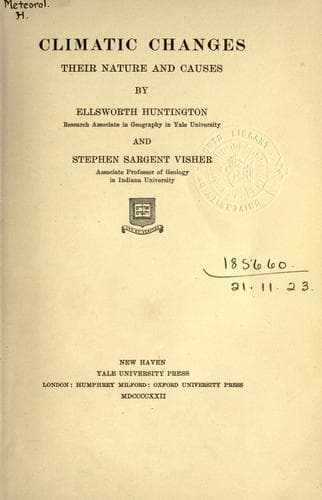
Climatic Changes: Their Nature and CausesHuntington, Ellsworth
Science
Climatic Changes: Their Nature and Causes
Huntington, Ellsworth
Climatic changes; Climatology; Paleoclimatology
If Alpha Centauri is really so important, the effect of its variations,
provided it has any, ought perhaps to be evident in the sun. The
activity of the star's atmosphere presumably varies, for the orbits of
the two components have an eccentricity of 0.51. Hence during their
period of revolution, 81.2 years, the distance between them ranges from
1,100,000,000 to 3,300,000,000 miles. They were at a minimum distance in
1388, 1459, 1550, 1631, 1713, 1794, 1875, and will be again in 1956. In
Fig. 11, showing sunspot variations, it is noticeable that the years
1794 and 1875 come just at the ends of periods of unusual solar
activity, as indicated by the heavy horizontal line. A similar period of
great activity seems to have begun about 1914. If its duration equals
the average of its two predecessors, it will end about 1950. Back in the
fourteenth century a period of excessive solar activity, which has
already been described, culminated from 1370 to 1385, or just before the
two parts of Alpha Centauri were at a minimum distance. Thus in three
and perhaps four cases the sun has been unusually active during a time
when the two parts of the star were most rapidly approaching each other
and when their atmospheres were presumably most disturbed and their
electrical emanations strongest.
[Illustration: _Fig. 11. Sunspot curve showing cycles, 1750 to 1920._
_Note._ The asterisks indicate two absolute minima of sunspots in 1810
and 1913, and the middle years (1780 and 1854) of two periods when the
sunspot maxima never fell below 95. If Alpha Centauri has an effect on
the sun's atmosphere, the end of another such period would be expected
not far from 1957.]
The fact that Alpha Centauri, the star which would be expected most
strongly to influence the sun, and hence the earth, was nearest the sun
at the climax of the last glacial epoch, and that today the solar
atmosphere is most active when the star is presumably most disturbed may
be of no significance. It is given for what it is worth. Its importance
lies not in the fact that it proves anything but that no contradiction
is found when we test the electro-stellar hypothesis by facts which were
not thought of when the hypothesis was framed. A vast amount of
astronomical work is still needed before the matter can be brought to
any definite conclusion. In case the hypothesis stands firm, it may be
possible to use the stars as a help in determining the exact chronology
of the later part of geological times. If the hypothesis is disproved,
it will merely leave the question of solar variations where it is today.
It will not influence the main conclusions of this book as to the causes
and nature of climatic changes. Its value lies in the fact that it calls
attention to new lines of research.
FOOTNOTES:
[Footnote 120: Lewis Boss: Convergent of a Moving Cluster in Taurus;
Astronom. Jour., Vol. 26, No. 4, 1908, pp. 31-36.]
[Footnote 121: F. R. Moulton: in Introduction to Astronomy, 1916.]
Public-domain text, read in full here on John Shaqi.
Reviews
Reviews
No reviews yet
Be the first to share your thoughts on this work.
Elsewhere in the archive
Join the Discussion
Join the discussion
Sign in to leave a comment or review.
Sign InorCreate an account