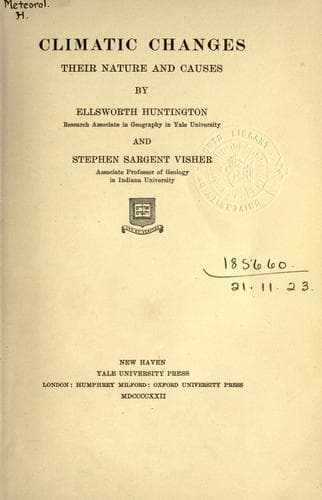
Climatic Changes: Their Nature and CausesHuntington, Ellsworth
Science
Climatic Changes: Their Nature and Causes
Huntington, Ellsworth
Climatic changes; Climatology; Paleoclimatology
[Footnote 122: A. Penck: Die Alpen im Eiszeitalter, Leipzig, 1909.]
[Footnote 123: R. D. Salisbury: Physical Geography of the Pleistocene,
in Outlines of Geologic History, by Willis and Salisbury, 1910, pp.
273-274.]
[Footnote 124: Davis, Pumpelly, and Huntington: Explorations in
Turkestan, Carnegie Inst. of Wash., No. 26, 1905.
In North America the stages have been the subject of intensive studies
on the part of Taylor, Leverett, Goldthwait, and many others.]
CHAPTER XVI
THE EARTH'S CRUST AND THE SUN
Although the problems of this book may lead far afield, they ultimately
bring us back to the earth and to the present. Several times in the
preceding pages there has been mention of the fact that periods of
extreme climatic fluctuations are closely associated with great
movements of the earth's crust whereby mountains are uplifted and
continents upheaved. In attempting to explain this association the
general tendency has been to look largely at the past instead of the
present. Hence it has been almost impossible to choose among three
possibilities, all beset with difficulties. First, the movements of the
crust may have caused the climatic fluctuations; second, climatic
changes may cause crustal movements; and third, variations in solar
activity or in some other outside agency may give rise to both types of
terrestrial phenomena.
The idea that movements of the earth's crust are the main cause of
geological changes of climate is becoming increasingly untenable as the
complexity and rapidity of climatic changes become more clear,
especially during post-glacial times. It implies that the earth's
surface moves up and down with a speed and facility which appear to be
out of the question. If volcanic activity be invoked the problem becomes
no clearer. Even if volcanic dust should fill the air frequently and
completely, neither its presence nor absence would produce such peculiar
features as the localization of glaciers, the distribution of loess, and
the mild climate of most parts of geological time. Nevertheless, because
of the great difficulties presented by the other two possibilities many
geologists still hold that directly or indirectly the greater climatic
changes have been mainly due to movements of the earth's crust and to
the reaction of the crustal movements on the atmosphere.
The possibility that climatic changes are in themselves a cause of
movements of the earth's crust seems so improbable that no one appears
to have investigated it with any seriousness. Nevertheless, it is worth
while to raise the question whether climatic extremes may cooeperate with
other agencies in setting the time when the earth's crust shall be
deformed.
Public-domain text, read in full here on John Shaqi.
Reviews
Reviews
No reviews yet
Be the first to share your thoughts on this work.
Elsewhere in the archive
Join the Discussion
Join the discussion
Sign in to leave a comment or review.
Sign InorCreate an account