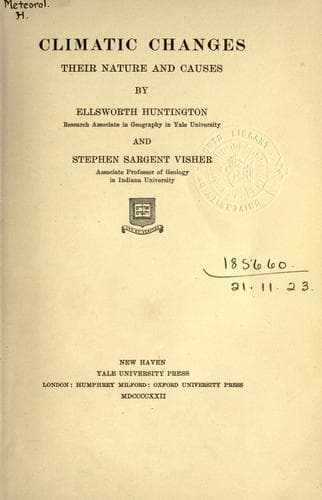
Climatic Changes: Their Nature and CausesHuntington, Ellsworth
Science
Climatic Changes: Their Nature and Causes
Huntington, Ellsworth
Climatic changes; Climatology; Paleoclimatology
According to the solar-cyclonic hypothesis such a condition is to be
expected. If the sun were especially active when the terrestrial
conditions prohibited glaciation, changes of climate would still occur,
but they would be milder than under other circumstances, and would leave
little record in the rocks. Or there might be glaciation in high
latitudes, such as that of southern Alaska in the Middle Silurian, and
none elsewhere. On the other hand, when the sun was so inactive that no
great storminess occurred, the upheaval of continents and the building
of mountains might go on without the formation of ice sheets, as
apparently happened at the end of the Mesozoic. The lack of absolute
coincidence between glaciation and periods of widespread emergence of
the lands is evident even today, for there is no reason to suppose that
the lands are notably lower or less extensive now than they were during
the Pleistocene glaciation. In fact, there is much evidence that many
areas have risen since that time. Yet glaciation is now far less
extensive than in the Pleistocene. Any attempt to explain this
difference on the basis of terrestrial changes is extremely difficult,
for the shape and altitude of continents and mountains have not changed
much in twenty or thirty thousand years. Yet the present moderately mild
epoch, like the puzzling inter-glacial epochs of earlier times, is
easily explicable on the assumption that the sun's atmosphere may
sometimes vary in harmony with crustal activity, but does not
necessarily do so at all times.
Turning now to the main problem of how climatic changes may be connected
with movements of the earth's crust, let us follow our usual method and
examine what is happening today. Let us first inquire whether
earthquakes, which are one of the chief evidences that crustal movements
are actually taking place in our own times, show any connection with
sunspots. In order to test this, we have compared _Milne's Catalogue of
Destructive Earthquakes_ from 1800 to 1899, with Wolf's sunspot numbers
for the same period month by month. The earthquake catalogue, as its
compiler describes it, "is an attempt to give a list of earthquakes
which have announced changes of geological importance in the earth's
crust; movements which have probably resulted in the creation or the
extension of a line of fault, the vibrations accompanying which could,
with proper instruments, have been recorded over a continent or the
whole surface of our world. Small earthquakes have been excluded, while
the number of large earthquakes both for ancient and modern times has
been extended. As an illustration of exclusion, I may mention that
between 1800 and 1808, which are years taken at random, I find in
Mallet's catalogue 407 entries. Only thirty-seven of these, which were
accompanied by structural damage, have been retained. Other catalogues
such as those of Perry and Fuchs have been treated similarly."[126]
Public-domain text, read in full here on John Shaqi.
Reviews
Reviews
No reviews yet
Be the first to share your thoughts on this work.
Elsewhere in the archive
Join the Discussion
Join the discussion
Sign in to leave a comment or review.
Sign InorCreate an account