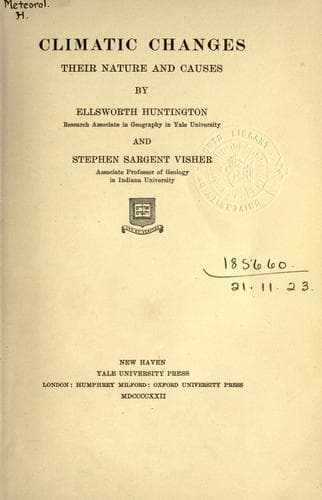
Climatic Changes: Their Nature and CausesHuntington, Ellsworth
Science
Climatic Changes: Their Nature and Causes
Huntington, Ellsworth
Climatic changes; Climatology; Paleoclimatology
If the earthquakes in such a carefully selected list bear a distinct
relation to sunspots, it is at least possible and perhaps probable that
a similar relation may exist between solar activity and geological
changes in the earth's crust. The result of the comparison of
earthquakes and sunspots is shown in Table 7. The first column gives the
sunspot numbers; the second, the number of months that had the
respective spot numbers during the century from 1800 to 1899. Column C
shows the total number of earthquakes during the months having any
particular degree of spottedness; while D, which is the significant
column, gives the average number of destructive earthquakes per month
under each of the six conditions of solar spottedness. The regularity of
column D is so great as to make it almost certain that we are here
dealing with a real relationship. Column F, which shows the average
number of earthquakes in the month succeeding any given condition of the
sun, is still more regular except for the last entry.
TABLE 7
DESTRUCTIVE EARTHQUAKES FROM 1800 TO 1899 COMPARED WITH SUNSPOTS
A: _Sunspot numbers_
B: _Number of months per Wolf's Table_
C: _Number of earthquakes_
D: _Average number of earthquakes per month_
E: _Number of earthquakes in succeeding month_
F: _Average number of earthquakes in succeeding month_
A B C D E F
0-15 344 522 1.52 512 1.49
15-30 194 306 1.58 310 1.60
30-50 237 433 1.83 439 1.85
50-70 195 402 2.06 390 2.00
70-100 135 286 2.12 310 2.30
over 100 95 218 2.30 175 1.84
The chance that six numbers taken at random will arrange themselves in
any given order is one in 720. In other words, there is one chance in
720 that the regularity of column D is accidental. But column F is as
regular as column D except for the last entry. If columns D and E were
independent there would be one chance in about 500,000 that the six
numbers in both columns would fall in the same order, and one chance in
14,400 that five numbers in each would fall in the same order. But the
two columns are somewhat related, for although the after-shocks of a
great earthquake are never included in Milne's table, a world-shaking
earthquake in one region during a given month probably creates
conditions that favor similar earthquakes elsewhere during the next
month. Hence the probability that we are dealing with a purely
accidental arrangement in Table 7 is less than one in 14,400 and greater
than one in 500,000. It may be one in 20,000 or 100,000. In any event it
is so slight that there is high probability that directly or indirectly
sunspots and earthquakes are somehow connected.
Public-domain text, read in full here on John Shaqi.
Reviews
Reviews
No reviews yet
Be the first to share your thoughts on this work.
Elsewhere in the archive
Join the Discussion
Join the discussion
Sign in to leave a comment or review.
Sign InorCreate an account