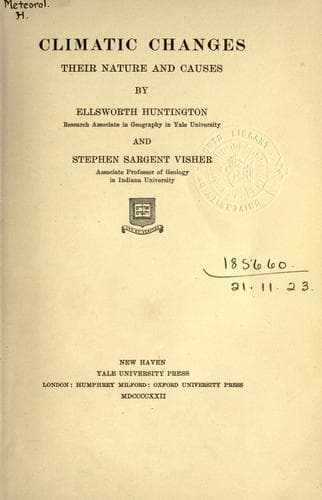
Climatic Changes: Their Nature and CausesHuntington, Ellsworth
Science
Climatic Changes: Their Nature and Causes
Huntington, Ellsworth
Climatic changes; Climatology; Paleoclimatology
The severe part of a climatic oscillation, as well as the mild part,
will be shown in later chapters to bear in itself certain probable seeds
of decay. While the lands are being uplifted, volcanic activity is
likely to be vigorous and to add carbon dioxide to the air. Later, as
the mountains are worn down by the many agencies of water, wind, ice,
and chemical decay, although much carbon dioxide is locked up by the
carbonation of the rocks, the carbon locked up in the coal is set free
and increases the carbon dioxide of the air. At the same time the
continents settle slowly downward, for the earth's crust though rigid as
steel is nevertheless slightly viscous and will flow if subjected to
sufficiently great and enduring pressure. The area from which
evaporation can take place is thereby increased because of the spread of
the oceans over the continents, and water vapor joins with the carbon
dioxide to blanket the earth and thus tends to keep it uniformly warm.
Moreover, the diminution of the lands frees the ocean currents from
restraint and permits them to flow more freely from low latitudes to
high. Thus in the course of millions of years there is a return toward
monotony. Ultimately, however, new stresses accumulate in the earth's
crust, and the way is prepared for another great oscillation. Perhaps
the setting free of the stresses takes place simply because the strain
at last becomes irresistible. It is also possible, as we shall see, that
an external agency sometimes adds to the strain and thereby determines
the time at which a new oscillation shall begin.
Public-domain text, read in full here on John Shaqi.
Reviews
Reviews
No reviews yet
Be the first to share your thoughts on this work.
Join the Discussion
Join the discussion
Sign in to leave a comment or review.
Sign InorCreate an account