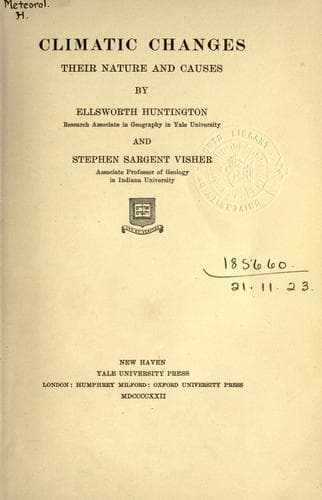
Climatic Changes: Their Nature and CausesHuntington, Ellsworth
Science
Climatic Changes: Their Nature and Causes
Huntington, Ellsworth
Climatic changes; Climatology; Paleoclimatology
It must not be supposed, however, that meteorological conditions are the
_cause_ of earthquakes and of movements of the earth's crust. Even
though the load that the climatic agencies can impose upon the earth's
crust runs into millions of tons per square mile, it is a trifle
compared with what the crust is able to support. There is, however, a
great difference between the cause and the occasion of a phenomenon.
Suppose that a thick sheet of glass is placed under an increasing
strain. If the strain is applied slowly enough, even so rigid a material
as glass will ultimately bend rather than break. But suppose that while
the tension is high the glass is tapped. A gentle tap may be followed by
a tiny crack. A series of little taps may be the signal for small cracks
to spread in every direction. A few slightly harder taps may cause the
whole sheet to break suddenly into many pieces. Yet even the hardest tap
may be the merest trifle compared with the strong force which is keeping
the glass in a state of strain and which would ultimately bend it if
given time.
The earth as a whole appears to stand between steel and glass in
rigidity. It is a matter of common observation that rocks stand high in
this respect and in the consequent difficulty with which they can be
bent without breaking. Because of the earth's contraction the crust
endures a constant strain, which must gradually become enormous. This
strain is increased by the fact that sediment is transferred from the
lands to the borders of the sea and there forms areas of thick
accumulation. From this has arisen the doctrine of isostasy, or of the
equalization of crustal pressure. An important illustration of this is
the oceanward and equatorial creep which has been described in Chapter
XI. There we saw that when the lands have once been raised to high
levels or when a shortening of the earth's axis by contraction has
increased the oceanic bulge at the equator, or when the reverse has
happened because of tidal retardation, the outer part of the earth
appears to creep slowly back toward a position of perfect isostatic
adjustment. If the sun had no influence upon the earth, either direct or
indirect, isostasy and other terrestrial processes might flex the
earth's crust so gradually that changes in the form and height of the
lands would always take place slowly, even from the geological point of
view. Thus erosion would usually be able to remove the rocks as rapidly
as they were domed above the general level. If this happened, mountains
would be rare or unknown, and hence climatic contrasts would be far less
marked than is actually the case on our earth where crustal movements
have repeatedly been rapid enough to produce mountains.
Public-domain text, read in full here on John Shaqi.
Reviews
Reviews
No reviews yet
Be the first to share your thoughts on this work.
Elsewhere in the archive
Join the Discussion
Join the discussion
Sign in to leave a comment or review.
Sign InorCreate an account