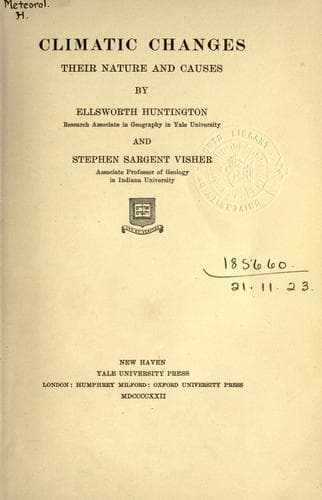
Climatic Changes: Their Nature and CausesHuntington, Ellsworth
Science
Climatic Changes: Their Nature and Causes
Huntington, Ellsworth
Climatic changes; Climatology; Paleoclimatology
Nature's methods rarely allow so gradual an adjustment to the forces of
isostasy. While the crust is under a strain, not only because of
contraction, but because of changes in its load through the transference
of sediments and the slow increase or decrease in the bulge at the
equator, the atmosphere more or less persistently carries on the tapping
process. The violence of that process varies greatly, and the variations
depend largely on the severity of the climatic contrasts. If the main
outlines of the cyclonic hypothesis are reliable, one of the first
effects of a disturbance of the sun's atmosphere is increased storminess
upon the earth. This is accompanied by increased intensity in almost
every meteorological process. The most important effect, however, so far
as the earth's crust is concerned would apparently be the rapid and
intense changes of atmospheric pressure which would arise from the swift
passage of one severe storm after another. Each storm would be a little
tap on the tensely strained crust. Any single tap might be of little
consequence, even though it involved a change of a billion tons in the
pressure on an area no larger than the state of Rhode Island. Yet a
rapid and irregular succession of such taps might possibly cause the
crust to crack, and finally to collapse in response to stresses arising
from the shrinkage of the earth.
Another and perhaps more important effect of variations in storminess
and especially in the location of the stormy areas would be an
acceleration of erosion in some places and a retardation elsewhere. A
great increase in rainfall may almost denude the slopes of soil, while a
diminution to the point where much of the vegetation dies off has a
similar effect. If such changes should take place rapidly, great
thicknesses of sediment might be concentrated in certain areas in a
short time, thus disturbing the isostatic adjustment of the earth's
crust. This might set up a state of strain which would ultimately have
to be relieved, thus perhaps initiating profound crustal movements.
Changes in the load of the earth's crust due to erosion and the
deposition of sediment, no matter how rapid they may be from the
geological standpoint, are slow compared with those due to changes in
barometric pressure. A drop of an inch in barometric pressure is
equivalent to the removal of about five inches of solid rock. Even under
the most favorable circumstances, the removal of an average depth of
five inches of rock or its equivalent in soil over millions of square
miles would probably take several hundred years, while the removal of a
similar load of air might occur in half a day or even a few hours. Thus
the erosion and deposition due to climatic variations presumably play
their part in crustal deformation chiefly by producing crustal stresses,
while the storms, as it were, strike sharp, sudden blows.
Public-domain text, read in full here on John Shaqi.
Reviews
Reviews
No reviews yet
Be the first to share your thoughts on this work.
Elsewhere in the archive
Join the Discussion
Join the discussion
Sign in to leave a comment or review.
Sign InorCreate an account