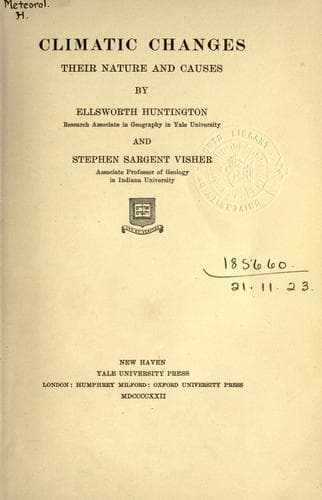
Climatic Changes: Their Nature and CausesHuntington, Ellsworth
Science
Climatic Changes: Their Nature and Causes
Huntington, Ellsworth
Climatic changes; Climatology; Paleoclimatology
Suppose now that a prolonged period of world-wide mild climate, such as
is described in Chapter X, should permit an enormous accumulation of
stresses due to contraction and tidal retardation. Suppose that then a
sudden change of climate should produce a rapid shifting of the deep
soil that had accumulated on the lands, with a corresponding
localization and increase in strains. Suppose also that frequent and
severe storms play their part, whether great or small, by producing an
intensive tapping of the crust. In such a case the ultimate collapse
would be correspondingly great, as would be evident in the succeeding
geological epoch. The sea floor might sink lower, the continents might
be elevated, and mountain ranges might be shoved up along lines of
special weakness. This is the story of the geological period as known to
historical geology. The force that causes such movements would be the
pull of gravity upon the crust surrounding the earth's shrinking
interior. Nevertheless climatic changes might occasionally set the date
when the gravitative pull would finally overcome inertia, and thus usher
in the crustal movements that close old geologic periods and inaugurate
new ones. This, however, could occur only if the crust were under
sufficient strain. As Lawson[139] says in his discussion of the "elastic
rebound theory," the sudden shifts of the crust which seem to be the
underlying cause of earthquakes "can occur only after the accumulation
of strain to a limit and ... this accumulation involves a slow creep of
the region affected. In the long periods between great earthquakes the
energy necessary for such shocks is being stored up in the rocks as
elastic compression."
If a period of intense storminess should occur when the earth as a whole
was in such a state of strain, the sudden release of the strains might
lead to terrestrial changes which would alter the climate still further,
making it more extreme, and perhaps permitting the storminess due to the
solar disturbances to bring about glaciation. At the same time if
volcanic activity should increase it would add its quota to the tendency
toward glaciation. Nevertheless, it might easily happen that a very
considerable amount of crustal movement would take place without causing
a continental ice sheet or even a marked alpine ice sheet. Or again, if
the strains in the earth's crust had already been largely released
through other agencies before the stormy period began, the climate might
become severe enough to cause glaciation in high latitudes without
leading to any very marked movements of the earth's crust, as apparently
happened in the Mid-Silurian period.
FOOTNOTES:
[Footnote 125: E. Kirk: Paleozoic Glaciation in Alaska; Am. Jour. Sci.,
1918, p. 511.]
[Footnote 126: J. Milne: Catalogue of Destructive Earthquakes; Rep.
Brit. Asso. Adv. Sci., 1911.]
[Footnote 127: Wm. Bowie: Lecture before the Geological Club of Yale
University. See Am. Jour. Sci., 1921.]
Public-domain text, read in full here on John Shaqi.
Reviews
Reviews
No reviews yet
Be the first to share your thoughts on this work.
Elsewhere in the archive
Join the Discussion
Join the discussion
Sign in to leave a comment or review.
Sign InorCreate an account