Climatic Changes: Their Nature and Causes — John Shaqi
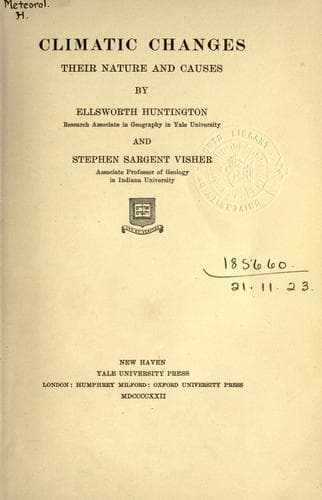
Climatic Changes: Their Nature and CausesHuntington, Ellsworth
Science
Climatic Changes: Their Nature and Causes
Huntington, Ellsworth
Climatic changes; Climatology; Paleoclimatology
From this rapid survey of the types of climatic sequences, it is evident
that they may be divided into four great groups. First comes cosmic
uniformity, one of the most marvelous and incomprehensible of all known
facts. We simply have no explanation which is in any respect adequate.
Next come secular progression and geologic oscillations, two types of
change which seem to be due mainly to purely terrestrial causes, that
is, to changes in the lands, the oceans, and the air. The general
tendency of these changes is toward complexity and diversity, thus
producing progression, but they are subject to frequent reversals which
give rise to oscillations lasting millions of years. The processes by
which the oscillations take place are fully discussed in this book.
Nevertheless, because they are fairly well understood, they are deferred
until after the third group of sequences has been discussed. This group
includes glacial fluctuations, historic pulsations, Brueckner periods,
sunspot cycles, pleionian migrations, and cyclonic vacillations. The
outstanding fact in regard to all of these is that while they are
greatly modified by purely terrestrial conditions, they seem to owe
their origin to variations in the sun. They form the chief subject of
_Earth and Sun_ and in their larger phases are the most important topic
of this book also. The last group of sequences includes orbital
precessions, seasonal alternations, and daily variations. These may be
regarded as purely solar in origin. Yet their influence, like that of
each of the other groups, is much modified by the earth's own
conditions. Our main problem is to separate and explain the two great
elements in climatic changes,--the effects of the sun, on the one hand,
and of the earth on the other.
CHAPTER III
HYPOTHESES OF CLIMATIC CHANGE
The next step in our study of climate is to review the main hypotheses
as to the causes of glaciation. These hypotheses apply also to other
types of climatic changes. We shall concentrate on glacial periods,
however, not only because they are the most dramatic and well-known
types of change, but because they have been more discussed than any
other and have also had great influence on evolution. Moreover, they
stand near the middle of the types of climatic sequences, and an
understanding of them does much to explain the others. In reviewing the
various theories we shall not attempt to cover all the ground, but shall
merely state the main ideas of the few theories which have had an
important influence upon scientific thought.
The conditions which any satisfactory climatic hypothesis must satisfy
are briefly as follows:
(1) Due weight must be given to the fact that changes of climate are
almost certainly due to the combined effect of a variety of causes, both
terrestrial and solar or cosmic.
Public-domain text, read in full here on John Shaqi.
Reviews
Reviews
No reviews yet
Be the first to share your thoughts on this work.
Join the Discussion
Join the discussion
Sign in to leave a comment or review.
Sign InorCreate an account