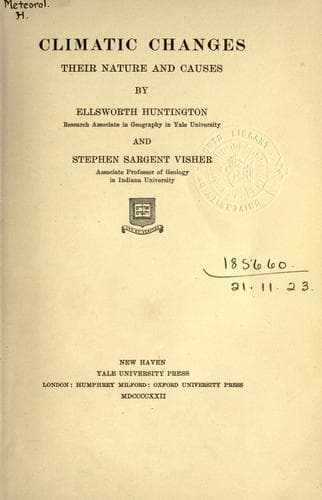
Climatic Changes: Their Nature and CausesHuntington, Ellsworth
Science
Climatic Changes: Their Nature and Causes
Huntington, Ellsworth
Climatic changes; Climatology; Paleoclimatology
VI. _The Thermal Solar Hypothesis._ The only other explanations of the
climatic changes of glacial and historic times which now seem to have
much standing are two distinct and almost antagonistic solar hypotheses.
One is the idea that changes in the earth's climate are due to
variations in the heat emitted by the sun and hence in the temperature
of the earth. The other is the entirely different idea that climatic
changes arise from solar conditions which cause a _redistribution of the
earth's atmospheric pressure_ and hence produce changes in winds, ocean
currents, and especially storms. This second, or "cyclonic," hypothesis
is the subject of a book entitled _Earth and Sun_, which is to be
published as a companion to the present volume. It will be outlined in
the next chapter. The other, or thermal, hypothesis may be dismissed
briefly. Unquestionably a permanent change in the amount of heat emitted
by the sun would permanently alter the earth's climate. There is
absolutely no evidence, however, of any such change during geologic
time. The evidence as to the earth's cosmic uniformity and as to secular
progression is all against it. Suppose that for thirty or forty thousand
years the sun cooled off enough so that the earth was as cool as during
a glacial epoch. As glaciation is soon succeeded by a mild climate, some
agency would then be needed to raise the sun's temperature. The impact
of a shower of meteorites might accomplish this, but that would mean a
very sudden heating, such as there is no evidence of in geological
history. In fact, there is far more evidence of sudden cooling than of
sudden heating. Moreover, it is far beyond the bounds of probability
that such an impact should be repeated again and again with just such
force as to bring the climate back almost to where it started and yet to
allow for the slight changes which cause secular progression. Another
and equally cogent objection to the thermal form of solar hypothesis is
stated by Humphreys as follows: "A change of the solar constant
obviously alters all surface temperatures by a roughly constant
percentage. Hence a decrease of the heat from the sun would in general
cause a decrease of the interzonal temperature gradients; and this in
turn a less vigorous atmospheric circulation, and a less copious rain or
snowfall--exactly the reverse of the condition, namely, abundant
precipitation, most favorable to extensive glaciation."
Public-domain text, read in full here on John Shaqi.
Reviews
Reviews
No reviews yet
Be the first to share your thoughts on this work.
Join the Discussion
Join the discussion
Sign in to leave a comment or review.
Sign InorCreate an account