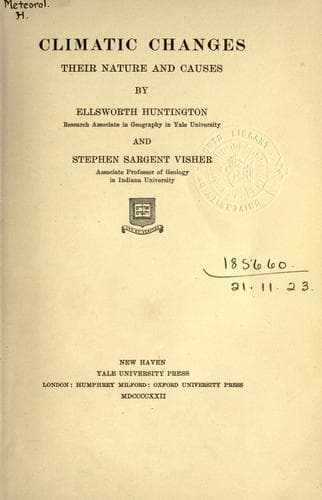
Climatic Changes: Their Nature and CausesHuntington, Ellsworth
Science
Climatic Changes: Their Nature and Causes
Huntington, Ellsworth
Climatic changes; Climatology; Paleoclimatology
The search for this auxiliary agency raises many difficult questions
which cannot yet be answered. On the whole the weight of evidence
suggests that electrical phenomena of some kind are involved, although
variations in the amount of ultra-violet light may also be important.
Many investigators have shown that the sun emits electrons. Hale has
proved that the sun, like the earth, is magnetized. Sunspots also have
magnetic fields the strength of which is often fifty times as great as
that of the sun as a whole. If electrons are sent to the earth, they
must move in curved paths, for they are deflected by the sun's magnetic
field and again by the earth's magnetic field. The solar deflection may
cause their effects to be greatest when the spots are near the sun's
margin; the terrestrial deflection may cause concentration in bands
roughly concentric with the magnetic poles of the earth. These
conditions correspond with the known facts.
Farther than this we cannot yet go. The calculations of Humphreys seem
to indicate that the direct electrical effect of the sun's electrons
upon atmospheric pressure is too small to be of appreciable significance
in intensifying storms. On the other hand the peculiar way in which
activity upon the margins of the sun appears to be correlated not only
with atmospheric electricity, but with barometric pressure, seems to be
equally strong evidence in the other direction. Possibly the sun's
electrons and its electrical waves produce indirect effects by being
converted into heat, or by causing the formation of ozone and the
condensation of water vapor in the upper air. Any one of these processes
would raise the temperature of the upper air, for the ozone and the
water vapor would be formed there and would tend to act as a blanket to
hold in the earth's heat. But any such change in the temperature of the
upper air would influence the lower air through changes in barometric
pressure. These considerations are given here because the thoughtful
reader is likely to inquire how solar activity can influence storminess.
Moreover, at the end of this book we shall take up certain speculative
questions in which an electrical hypothesis will be employed. For the
main portions of this book it makes no difference how the sun's
variations influence the earth's atmosphere. The only essential point is
that when the solar atmosphere is active the storminess of the earth
increases, and that is a matter of direct observation.
Public-domain text, read in full here on John Shaqi.
Reviews
Reviews
No reviews yet
Be the first to share your thoughts on this work.
Join the Discussion
Join the discussion
Sign in to leave a comment or review.
Sign InorCreate an account