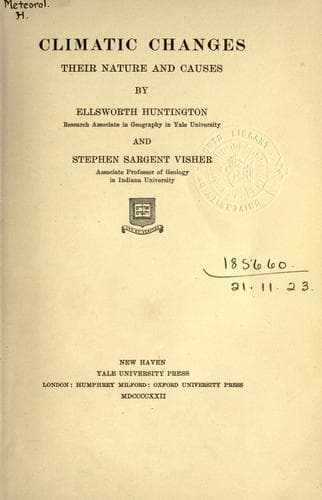
Climatic Changes: Their Nature and CausesHuntington, Ellsworth
Science
Climatic Changes: Their Nature and Causes
Huntington, Ellsworth
Climatic changes; Climatology; Paleoclimatology
Even more clear is the evidence from other regions where storms increase
at times of many sunspots. One such region includes the southwestern
United States, while another is the Mediterranean region and the
semi-arid or desert parts of Asia farther east. In these regions
innumerable ruins and other lines of evidence show that at the climax of
each climatic pulsation there was more storminess and rainfall than at
present, just as there now is when the sun is most active. In still
earlier times, while ice was accumulating farther north, the basins of
these semi-arid regions were filled with lakes whose strands still
remain to tell the tale of much-increased rainfall and presumable
storminess. If we go back still further in geological times to the
Permian glaciation, the areas where ice accumulated most abundantly
appear to be the regions where tropical hurricanes produce the greatest
rainfall and the greatest lowering of temperature at times of many
sunspots. From these and many other lines of evidence it seems probable
that historic pulsations and glacial fluctuations are nothing more than
sunspot cycles on a large scale. It is one of the fundamental rules of
science to reason from the known to the unknown, from the near to the
far, from the present to the past. Hence it seems advisable to
investigate whether any of the climatic phenomena of the past may have
arisen from an intensification of the solar conditions which now appear
to give rise to similar phenomena on a small scale.
Public-domain text, read in full here on John Shaqi.
Reviews
Reviews
No reviews yet
Be the first to share your thoughts on this work.
Join the Discussion
Join the discussion
Sign in to leave a comment or review.
Sign InorCreate an account