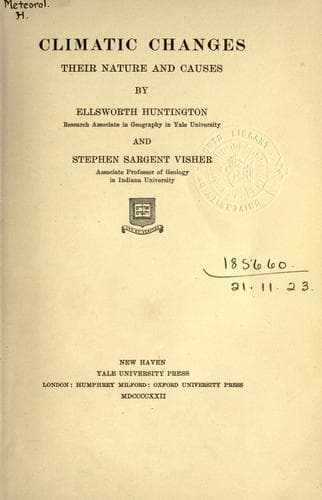
Climatic Changes: Their Nature and CausesHuntington, Ellsworth
Science
Climatic Changes: Their Nature and Causes
Huntington, Ellsworth
Climatic changes; Climatology; Paleoclimatology
The conditions which prevail at times of increased storminess have been
discussed in detail in _Earth and Sun_. Those which apparently brought
on glaciation seem to have acted as follows: In the first place the
storminess lowered the temperature of the earth's surface in several
ways. The most important of these was the rapid upward convection in the
centers of cyclonic storms whereby abundant heat was carried to high
levels where most of it was radiated away into space. The marked
increase in the number of tropical cyclones which accompanies increased
solar activity was probably important in this respect. Such cyclones
carry vast quantities of heat and moisture out of the tropics. The
moisture, to be sure, liberates heat upon condensing, but as
condensation occurs above the earth's surface, much of the heat escapes
into space. Another reason for low temperature was that under the
influence of the supposedly numerous storms of Pleistocene times
evaporation over the oceans must have increased. This is largely because
the velocity of the winds is relatively great when storms are strong and
such winds are powerful agents of evaporation. But evaporation requires
heat, and hence the strong winds lower the temperature.[B]
The second great condition which enabled increased storminess to bring
on glaciation was the location of the storm tracks. Kullmer's maps, as
illustrated in Fig. 2, suggest that a great increase in solar activity,
such as is postulated in the Pleistocene, might shift the main storm
track poleward even more than it is shifted by the milder solar changes
during the twelve-year sunspot cycle. If this is so, the main track
would tend to cross North America through the middle of Canada instead
of near the southern border. Thus there would be an increase in
precipitation in about the latitude of the Keewatin and Labradorean
centers of glaciation. From what is known of storm tracks in Europe, the
main increase in the intensity of storms would probably center in
Scandinavia. Fig. 3 in Chapter V bears this out. That figure, it will be
recalled, shows what happens to precipitation when solar activity is
increasing. A high rate of precipitation is especially marked in the
boreal storm track, that is, in the northern United States, southern
Canada, and northwestern Europe.
Public-domain text, read in full here on John Shaqi.
Reviews
Reviews
No reviews yet
Be the first to share your thoughts on this work.
Elsewhere in the archive
Join the Discussion
Join the discussion
Sign in to leave a comment or review.
Sign InorCreate an account