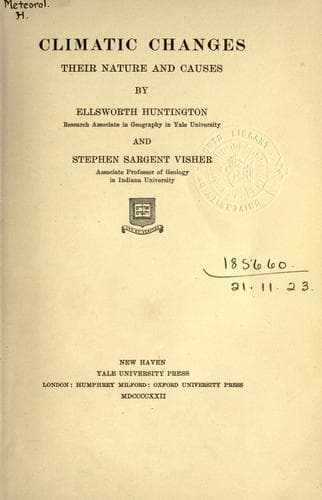
Climatic Changes: Their Nature and CausesHuntington, Ellsworth
Science
Climatic Changes: Their Nature and Causes
Huntington, Ellsworth
Climatic changes; Climatology; Paleoclimatology
According to the solar-cyclonic hypothesis, the Pleistocene glacial
period was inaugurated at a time when certain terrestrial conditions
tended to make the earth especially favorable for glaciation. How these
conditions arose will be considered later. Here it is enough to state
what they were. Chief among them was the fact that the continents stood
unusually high and were unusually large. This, however, was not the
primary cause of glaciation, for many of the areas which were soon to be
glaciated were little above sea level. For example, it seems clear that
New England stood less than a thousand feet higher than now. Indeed,
Salisbury[39] estimates that eastern North America in general stood not
more than a few hundred feet higher than now, and W. B. Wright[40]
reaches the same conclusion in respect to the British Isles.
Nevertheless, widespread lands, even if they are not all high, lead to
climatic conditions which favor glaciation. For example, enlarged
continents cause low temperature in high latitudes because they
interfere with the ocean currents that carry heat polewards. Such
continents also cause relatively cold winters, for lands cool much
sooner than does the ocean. Another result is a diminution of water
vapor, not only because cold air cannot hold much vapor, but also
because the oceanic area from which evaporation takes place is reduced
by the emergence of the continents. Again, when the continents are
extensive the amount of carbonic acid gas in the atmosphere probably
decreases, for the augmented erosion due to uplift exposes much igneous
rock to the air, and weathering consumes the atmospheric carbon dioxide.
When the supply of water vapor and of atmospheric carbon dioxide is
small, an extreme type of climate usually prevails. The combined result
of all these conditions is that continental emergence causes the climate
to be somewhat cool and to be marked by relatively great contrasts from
season to season and from latitude to latitude.
When the terrestrial conditions thus permitted glaciation, unusual solar
activity is supposed to have greatly increased the number and severity
of storms and to have altered their location, just as now happens at
times of many sunspots. If such a change in storminess had occurred when
terrestrial conditions were unfavorable for glaciation, as, for example,
when the lands were low and there were widespread epicontinental seas in
middle and high latitudes, glaciation might not have resulted. In the
Pleistocene, however, terrestrial conditions permitted glaciation, and
therefore the supposed increase in storminess caused great ice sheets.
Public-domain text, read in full here on John Shaqi.
Reviews
Reviews
No reviews yet
Be the first to share your thoughts on this work.
Elsewhere in the archive
Join the Discussion
Join the discussion
Sign in to leave a comment or review.
Sign InorCreate an account