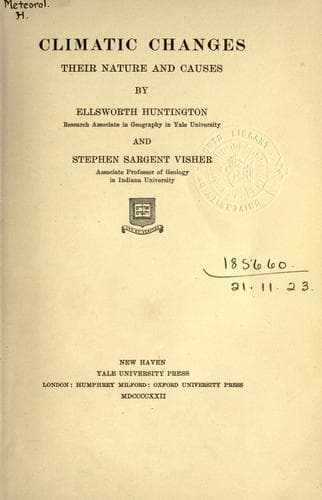
Climatic Changes: Their Nature and CausesHuntington, Ellsworth
Science
Climatic Changes: Their Nature and Causes
Huntington, Ellsworth
Climatic changes; Climatology; Paleoclimatology
If events at the beginning of the last glacial period took place in
accordance with the cyclonic hypothesis, as outlined above, one of the
inevitable results would be the production of snowfields. The places
where snow would accumulate in special quantities would be central
Canada, the Labrador plateau, and Scandinavia, as well as certain
mountain regions. As soon as a snowfield became somewhat extensive, it
would begin to produce striking climatic alterations in addition to
those to which it owed its origin.[41] For example, within a snowfield
the summers remain relatively cold. Hence such a field is likely to be
an area of high pressure at all seasons. The fact that the snowfield is
always a place of relatively high pressure results in outblowing surface
winds except when these are temporarily overcome by the passage of
strong cyclonic storms. The storms, however, tend to be concentrated
near the margins of the ice throughout the year instead of following
different paths in each of the four seasons. This is partly because
cyclonic lows always avoid places of high pressure and are thus pushed
out of the areas where permanent snow has accumulated. On the other
hand, at times of many sunspots, as Kullmer has shown, the main storm
track tends to be drawn poleward, perhaps by electrical conditions.
Hence when a snowfield is present in the north, the lows, instead of
migrating much farther north in summer than in winter, as they now do,
would merely crowd on to the snowfield a little farther in summer than
in winter. Thus the heavy precipitation which is usual in humid climates
near the centers of lows would take place near the advancing margin of
the snowfield and cause the field to expand still farther southward.
The tendency toward the accumulation of snow on the margins of the
snowfields would be intensified not only by the actual storms
themselves, but by other conditions. For example, the coldness of the
snow would tend to cause prompt condensation of the moisture brought by
the winds that blow toward the storm centers from low latitudes. Again,
in spite of the general dryness of the air over a snowfield, the lower
air contains some moisture due to evaporation from the snow by day
during the clear sunny weather of anti-cyclones or highs. Where this is
sufficient, the cold surface of the snowfields tends to produce a frozen
fog whenever the snowfield is cooled by radiation, as happens at night
and during the passage of highs. Such a frozen fog is an effective
reflector of solar radiation. Moreover, because ice has only half the
specific heat of water, and is much more transparent to heat, such a
"radiation fog" composed of ice crystals is a much less effective
retainer of heat than clouds or fog made of unfrozen water particles.
Shallow fogs of this type are described by several polar expeditions.
They clearly retard the melting of the snow and thus help the icefield
to grow.
Public-domain text, read in full here on John Shaqi.
Reviews
Reviews
No reviews yet
Be the first to share your thoughts on this work.
Elsewhere in the archive
Join the Discussion
Join the discussion
Sign in to leave a comment or review.
Sign InorCreate an account