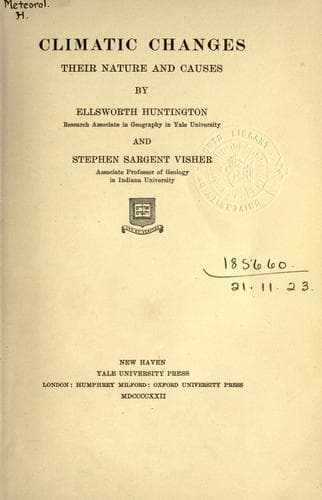
Climatic Changes: Their Nature and CausesHuntington, Ellsworth
Science
Climatic Changes: Their Nature and Causes
Huntington, Ellsworth
Climatic changes; Climatology; Paleoclimatology
For all these reasons, so long as storminess remained great, the
Pleistocene snowfields, according to the solar hypothesis, must have
deepened and expanded. In due time some of the snow was converted into
glacial ice. When that occurred, the growth of the snowfield as well as
of the ice cap must have been accelerated by glacial movement. Under
such circumstances, as the ice crowded southward toward the source of
the moisture by which it grew, the area of high pressure produced by its
low temperature would expand. This would force the storm track southward
in spite of the contrary tendency due to the sun. When the ice sheet had
become very extensive, the track would be crowded relatively near to the
northern margin of the trade-wind belt. Indeed, the Pleistocene ice
sheets, at the time of their maximum extension, reached almost as far
south as the latitude now marking the northern limit of the trade-wind
belt in summer. As the storm track with its frequent low pressure and
the subtropical belt with its high pressure were forced nearer and
nearer together, the barometric gradient between the two presumably
became greater, winds became stronger, and the storms more intense.
This zonal crowding would be of special importance in summer, at which
time it would also be most pronounced. In the first place, the storms
would be crowded far upon the ice cap which would then be protected from
the sun by a cover of fog and cloud more fully than at any other season.
Furthermore, the close approach of the trade-wind belt to the storm belt
would result in a great increase in the amount of moisture drawn from
the belt of evaporation which the trade winds dominate. In the
trade-wind belt, clear skies and high temperature make evaporation
especially rapid. Indeed, in spite of the vast deserts it is probable
that more than three-fourths of the total evaporation now taking place
on the earth occurs in the belt of trades, an area which includes about
one-half of the earth's surface.
Public-domain text, read in full here on John Shaqi.
Reviews
Reviews
No reviews yet
Be the first to share your thoughts on this work.
Elsewhere in the archive
Join the Discussion
Join the discussion
Sign in to leave a comment or review.
Sign InorCreate an account