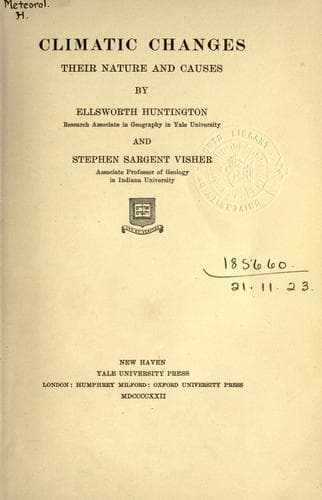
Climatic Changes: Their Nature and CausesHuntington, Ellsworth
Science
Climatic Changes: Their Nature and Causes
Huntington, Ellsworth
Climatic changes; Climatology; Paleoclimatology
In addition to the consequences of the crowding of the storm track
toward the trade-wind belt, several other conditions presumably operated
to favor the growth of the ice sheet. For example, the lowering of the
sea level by the removal of water to form the snowfields and glaciers
interfered with warm currents. It also increased the rate of erosion,
for it was equivalent to an uplift of all the land. One consequence of
erosion and weathering was presumably a diminution of the carbon dioxide
in the atmosphere, for although the ice covered perhaps a tenth of the
lands and interfered with carbonation to that extent, the removal of
large quantities of soil by accelerated erosion on the other nine-tenths
perhaps more than counterbalanced the protective effect of the ice. At
the same time, the general lowering of the temperature of the ocean as
well as the lands increased the ocean's capacity for carbon dioxide and
thus facilitated absorption. At a temperature of 50 deg.F. water absorbs 32
per cent more carbon dioxide than at 68 deg.. The high waves produced by the
severe storms must have had a similar effect on a small scale. Thus the
percentage of carbon dioxide in the atmosphere was presumably
diminished. Of less significance than these changes in the lands and the
air, but perhaps not negligible, was the increased salinity of the ocean
which accompanied the removal of water to form snow, and the increase of
the dissolved mineral load of the rejuvenated streams. Increased
salinity slows up the deep-sea circulation, as we shall see in a later
chapter. This increases the contrasts from zone to zone.
At times of great solar activity the agencies mentioned above would
apparently cooeperate to cause an advance of ice sheets into lower
latitudes. The degree of solar activity would have much to do with the
final extent of the ice sheets. Nevertheless, certain terrestrial
conditions would tend to set limits beyond which the ice would not
greatly advance unless the storminess were extraordinarily severe. The
most obvious of these conditions is the location of oceans and of
deserts or semi-arid regions. The southwestward advance of the European
ice sheet and the southeastward advance of the Labradorean sheet in
America were stopped by the Atlantic. The semi-aridity of the Great
Plains, produced by their position in the lee of the Rocky Mountains,
stopped the advance of the Keewatin ice sheet toward the southwest. The
advance of the European ice sheet southeast seems to have been stopped
for similar reasons. The cessation of the advance would be brought about
in such an area not alone by the light precipitation and abundant
sunshine, but by the dryness of the air, and also by the power of dust
to absorb the sun's heat. Much dust would presumably be drawn in from
the dry regions by passing cyclonic storms and would be scattered over
the ice.
Public-domain text, read in full here on John Shaqi.
Reviews
Reviews
No reviews yet
Be the first to share your thoughts on this work.
Elsewhere in the archive
Join the Discussion
Join the discussion
Sign in to leave a comment or review.
Sign InorCreate an account