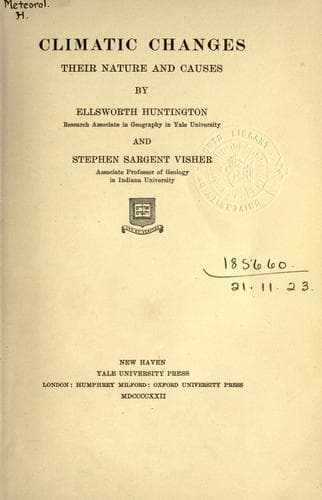
Climatic Changes: Their Nature and CausesHuntington, Ellsworth
Science
Climatic Changes: Their Nature and Causes
Huntington, Ellsworth
Climatic changes; Climatology; Paleoclimatology
The advance of the ice is also slowed up by a rugged topography, as
among the Appalachians in northern Pennsylvania. Such a topography
besides opposing a physical obstruction to the movement of the ice
provides bare south-facing slopes which the sun warms effectively. Such
warm slopes are unfavorable to glacial advance. The rugged topography
was perhaps quite as effective as the altitude of the Appalachians in
causing the conspicuous northward dent in the glacial margin in
Pennsylvania. Where glaciers lie in mountain valleys the advance beyond
a certain point is often interfered with by the deployment of the ice at
the mouths of gorges. Evaporation and melting are more rapid where a
glacier is broad and thin than where it is narrow and thick, as in a
gorge. Again, where the topography or the location of oceans or dry
areas causes the glacial lobes to be long and narrow, the elongation of
the lobe is apparently checked in several ways. Toward the end of the
lobe, melting and evaporation increase rapidly because the planetary
westerly winds are more likely to overcome the glacial winds and sweep
across a long, narrow lobe than across a broad one. As they cross the
lobe, they accelerate evaporation, and probably lessen cloudiness, with
a consequent augmentation of melting. Moreover, although lows rarely
cross a broad ice sheet, they do cross a narrow lobe. For example,
Nansen records that strong lows occasionally cross the narrow southern
part of the Greenland ice sheet. The longer the lobe, the more likely it
is that lows will cross it, instead of following its margin. Lows which
cross a lobe do not yield so much snow to the tip as do those which
follow the margin. Hence elongation is retarded and finally stopped even
without a change in the earth's general climate.
Because of these various reasons the advances of the ice during the
several epochs of a glacial period might be approximately equal, even if
the durations of the periods of storminess and low temperature were
different. Indeed, they might be sub-equal, even if the periods differed
in intensity as well as length. Differences in the periods would
apparently be manifested less in the extent of the ice than in the depth
of glacial erosion and in the thickness of the terminal moraines,
outwash plains, and other glacial or glacio-fluvial formations.
Public-domain text, read in full here on John Shaqi.
Reviews
Reviews
No reviews yet
Be the first to share your thoughts on this work.
Elsewhere in the archive
Join the Discussion
Join the discussion
Sign in to leave a comment or review.
Sign InorCreate an account