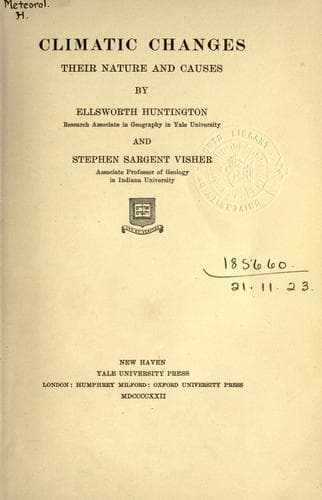
Climatic Changes: Their Nature and CausesHuntington, Ellsworth
Science
Climatic Changes: Their Nature and Causes
Huntington, Ellsworth
Climatic changes; Climatology; Paleoclimatology
In this vast field of snow the glacial ice slowly crept outward,
possibly at an average speed of half a foot a day, but varying from
almost nothing in winter at the north, to several feet a day in summer
at the south.[44] The force which caused the movement was the presence
of the ice piled up not far from the margins. Almost certainly, however,
there was no great dome from the center in Canada outward, as some early
writers assumed. Such a dome would require that the ice be many
thousands of feet thick near its center. This is impossible because of
the fact that ice is more voluminous than water (about 9 per cent near
the freezing point). Hence when subjected to sufficient pressure it
changes to the liquid form. As friction and internal heat tend to keep
the bottom of a glacier warm, even in cold regions, the probabilities
are that only under very special conditions was a continental ice sheet
much thicker than about 2500 feet. In Antarctica, where the temperature
is much lower than was probably attained in the United States, the ice
sheet is nearly level, several expeditions having traveled hundreds of
miles with practically no change in altitude. In Shackleton's trip
almost to the South Pole, he encountered a general rise of 3000 feet in
1200 miles. Mountains, however, projected through the ice even near the
pole and the geologists conclude that the ice is not very thick even at
the world's coldest point, the South Pole.
Along the margin of the ice there were two sorts of movement, much more
rapid than the slow creep of the ice. One was produced by the outward
drift of snow carried by the outblowing dry winds and the other and more
important was due to the passage of cyclonic storms. Along the border of
the ice sheet, except at the north, storm presumably closely followed
storm. Their movement, we judge, was relatively slow until near the
southern end of the Mississippi lobe, but when this point was passed
they moved much more rapidly, for then they could go toward instead of
away from the far northern path which the sun prescribes when solar
activity is great. The storms brought much snow to the icefield, perhaps
sometimes in favored places as much as the hundred feet a year which is
recorded for some winters in the Sierras at present. Even the
unglaciated intermontane Great Basin presumably received considerable
precipitation, perhaps twice as much as its present scanty supply. The
rainfall was enough to support many lakes, one of which was ten times as
large as Great Salt Lake; and grass was doubtless abundant upon many
slopes which are now dry and barren. The relatively heavy precipitation
in the Great Basin was probably due primarily to the increased number of
storms, but may also have been much influenced by their slow eastward
movement. The lows presumably moved slowly in that general region not
only because they were retarded and turned from their normal path by the
Public-domain text, read in full here on John Shaqi.
Reviews
Reviews
No reviews yet
Be the first to share your thoughts on this work.
Elsewhere in the archive
Join the Discussion
Join the discussion
Sign in to leave a comment or review.
Sign InorCreate an account