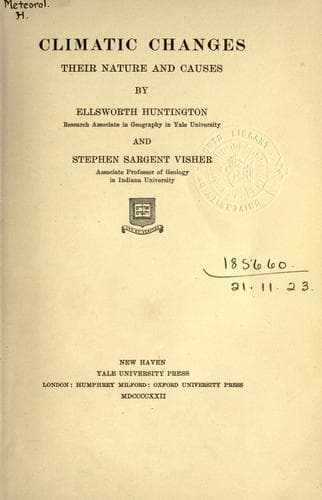
Climatic Changes: Their Nature and CausesHuntington, Ellsworth
Science
Climatic Changes: Their Nature and Causes
Huntington, Ellsworth
Climatic changes; Climatology; Paleoclimatology
cold ice to the east, but because during the summer the area between the
Sierra snowfields on the west and the Rocky Mountain and Mississippi
Valley snowfields on the east was relatively warm. Hence it was normally
a place of low pressure and therefore of inblowing winds. Slow-moving
lows are much more effective than fast-moving ones in drawing moisture
northwestward from the Gulf of Mexico, for they give the moisture more
time to move spirally first northeast, under the influence of the normal
southwesterly winds, then northwest and finally southwest as it
approaches the storm center. In the case of the present lows, before
much moisture-laden air can describe such a circuit, first eastward and
then westward, the storm center has nearly always moved eastward across
the Rockies and even across the Great Plains. A result of this is the
regular decrease in precipitation northward, northwestward, and westward
from the Gulf of Mexico.
Along the part of the glacial margins where for more than 3000 miles the
North American ice entered the Atlantic and the Pacific oceans, myriads
of great blocks broke off and floated away as stately icebergs, to
scatter boulders far over the ocean floor and to melt in warmer climes.
Where the margin lay upon the lands numerous streams issued from beneath
the ice, milk-white with rock flour, and built up great outwash plains
and valley trains of gravel and sand. Here and there, just beyond the
ice, marginal lakes of strange shapes occupied valleys which had been
dammed by the advancing ice. In many of them the water level rose until
it reached some low point in the divide and then overflowed, forming
rapids and waterfalls. Indeed, many of the waterfalls of the eastern
United States and Canada were formed in just this way and not a few
streams now occupy courses through ridges instead of parallel to them,
as in pre-glacial times.
In the zone to the south of the continental ice sheet, the plant and
animal life of boreal, cool temperate, and warm temperate regions
commingled curiously. Heather and Arctic willow crowded out elm and oak;
musk ox, hairy mammoth, and marmot contested with deer, chipmunk, and
skunk for a chance to live. Near the ice on slopes exposed to the cold
glacial gales, the immigrant boreal species were dominant, but not far
away in more protected areas the species that had formerly lived there
held their own. In Europe during the last two advances of the great ice
sheet the caveman also struggled with fierce animals and a fiercer
climate to maintain life in an area whose habitability had long been
decreasing.
Public-domain text, read in full here on John Shaqi.
Reviews
Reviews
No reviews yet
Be the first to share your thoughts on this work.
Elsewhere in the archive
Join the Discussion
Join the discussion
Sign in to leave a comment or review.
Sign InorCreate an account