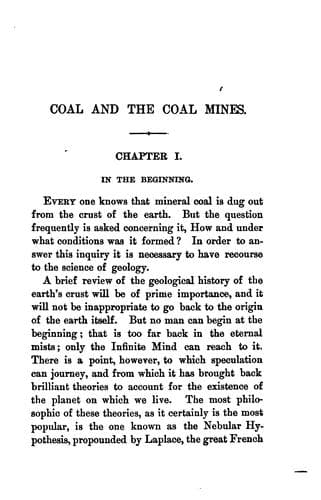
Although it has been within comparatively recent times that coal has
come into general use as a fuel, yet there can be no doubt that it was
discovered, and that its qualities were known, many centuries ago. To
prove its use by the ancients, mention is sometimes made of a passage
from the writings of Theophrastus, a pupil and friend of Aristotle
and for many years the head of the peripatetic school of philosophy.
This passage dates back to about 300 B. C., and is as follows: “Those
substances that are called coals and are broken for use are earthy, but
they kindle and burn like wooden coals. They are found in Liguria where
there is amber, and in Elis over the mountains toward Olympus. They are
used by the smiths.”
The word “coal,” however, as used in the Bible and other ancient
books, usually means charcoal, or burning wood. It is claimed, and
not without plausibility, that coal was mined in Britain prior to the
Roman invasion. The cinder heaps found among ruins of the time of Roman
supremacy in the island point to quite an extensive use of coal by the
people of that age. But no writings have been found recording the use
of coal prior to 852 A. D. In that year twelve cartloads of “fossil
fuel,” or “pit coal,” were received by the abbey of Peterborough in
England, and the receipt was recorded. It is said that coal first began
to be systematically mined in Great Britain about the year 1180.
It is certain that by the end of the thirteenth century the exportation
of coal from Newcastle was considerable, and the new fuel had come
to be largely used in London. But the people of that city conceived
the idea that its use was injurious to the health of the inhabitants
generally. The coal, being of the bituminous variety, burned with
considerable flame and gave off a good deal of smoke, and the ignorance
of the people led them into the belief that the air was contaminated
and poisoned by the products of combustion. So they presented a
petition to Parliament asking that the burning of coal be prohibited in
the city of London. Not only was the prayer of the petitioners granted,
but in order to render the prohibition effectual an act was passed
making it a capital offense to burn the dreaded fuel. This was in the
reign of Edward I., and is characteristic of the policy of that strong,
unyielding king, whose ends, great and just perhaps, were too often
attained by harsh and cruel means.
The coal industry was checked, but it was not destroyed; for, half
a century later, we find Edward III. granting a license to the
inhabitants of Newcastle “to dig coals and stones in the common soil of
the town without the walls thereof in the place called the Castle Field
and the Forth.” Afterward this town, owing to the fine coal beds in its
vicinity, became one of the great centres of the British coal trade,
from which fact doubtless arose that ancient saying concerning useless
trouble or labor, that it is like “carrying coals to Newcastle.”
Public-domain text, read in full here on John Shaqi.
Reviews
Reviews
No reviews yet
Be the first to share your thoughts on this work.
Join the Discussion
Join the discussion
Sign in to leave a comment or review.
Sign InorCreate an account