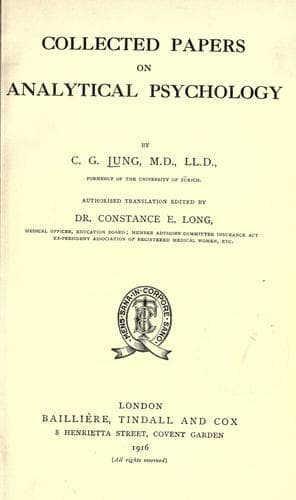
Collected Papers on Analytical PsychologyJung, C. G. (Carl Gustav)
Science
Collected Papers on Analytical Psychology
Jung, C. G. (Carl Gustav)
Psychoanalysis
These examples show in the first place that many other words connect
themselves with the reaction word. The test person is unable to suppress
the ideas which subsequently occur to her. She also pursues a certain
tendency which perhaps is more exactly expressed in the following
reaction: new--old--as an opposite. The addition of "as an opposite"
denotes that the test-person has the desire to add something explanatory
or supplementary. This tendency is also shown in the following reaction:
finger--not only hand, also foot--a limb--member--extremity.
Here we have a whole series of supplements. It seems as if the reaction
were not sufficient for the test-person, something else must always
be added, as if what has already been said were incorrect or in some
way imperfect. This feeling is what Janet designates the "_sentiment
d'incomplétude_," but this by no means explains everything. I go
somewhat deeply into this phenomenon because it is very frequently met
with in neurotic individuals. It is not merely a small and unimportant
subsidiary manifestation demonstrable in an insignificant experiment,
but rather an elemental and universal manifestation which plays a _rôle_
in other ways in the psychic life of neurotics.
By his desire to supplement, the test-person betrays a tendency to give
the experimenter more than he wants, he actually makes great efforts to
find further mental occurrences in order finally to discover something
quite satisfactory. If we translate this observation into the psychology
of everyday life, it signifies that the test-person has a constant
tendency to give to others more feeling than is required and expected.
According to Freud, this is a sign of a reinforced object-libido, that
is, it is a compensation for an inner want of satisfaction and voidness
of feeling. This elementary observation therefore displays one of the
characteristics of hysterics, namely, the tendency to allow themselves
to be carried away by everything, to attach themselves enthusiastically
to everything, and always to promise too much and hence perform too
little. Patients with this symptom are, in my experience, always hard
to deal with; at first they are enthusiastically enamoured of the
physician, for a time going so far as to accept everything he says
blindly; but they soon merge into an equally blind resistance against
him, thus rendering any educative influence absolutely impossible.
We see therefore in this type of reaction an expression of a tendency to
give more than is asked or expected. This tendency betrays itself also
in other failures to follow the instruction:--
to quarrel--angry--different things--I always quarrel at home;
to marry--how can you marry?--reunion--union;
plum--to eat--to pluck--what do you mean by it?--is it symbolic?
to sin--this idea is quite strange to me, I do not recognise it.
Public-domain text, read in full here on John Shaqi.
Reviews
Reviews
No reviews yet
Be the first to share your thoughts on this work.
Elsewhere in the archive
Join the Discussion
Join the discussion
Sign in to leave a comment or review.
Sign InorCreate an account