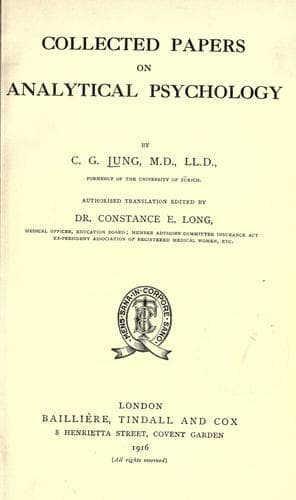
Collected Papers on Analytical PsychologyJung, C. G. (Carl Gustav)
Science
Collected Papers on Analytical Psychology
Jung, C. G. (Carl Gustav)
Psychoanalysis
These reactions show that the test-person gets away altogether from the
situation of the experiment. For the instruction was, that he should
answer only with the first word which occurs to him. But here we note
that the stimulus words act with excessive strength, that they are taken
as if they were direct personal questions. The test-person entirely
forgets that we deal with mere words which stand in print before us, but
finds a personal meaning in them; he tries to divine their intention and
defend himself against them, thus altogether forgetting the original
instructions.
This elementary observation discloses another common peculiarity of
hysterics, namely, that of taking everything personally, of never being
able to remain objective, and of allowing themselves to be carried away
by momentary impressions; this again shows the characteristics of the
enhanced object-libido.
Yet another sign of impeded adaptation is the often occurring
_repetition of the stimulus words_. The test-persons repeat the stimulus
word as if they had not heard or understood it distinctly. They repeat
it just as we repeat a difficult question in order to grasp it better
before answering. This same tendency is shown in the experiment. The
questions are repeated because the stimulus words act on hysterical
individuals in much the same way as difficult personal questions. In
principle it is the same phenomenon as the subsequent completion of the
reaction.
In many experiments we observe that the same reaction constantly
reappears to the most varied stimulus words. These words seem to possess
a special reproduction tendency, and it is very interesting to examine
their relationship to the test-person. For example, I have observed a
case in which the patient repeated the word "short" a great many times
and often in places where it had no meaning. The test-person could not
directly state the reason for the repetition of the word "short." From
experience I knew that such predicates always relate either to the
test-person himself or to the person nearest to him. I assumed that
in this word "short" he designated himself, and that in this way he
helped to express something very painful to him. The test-person is
of very small stature. He is the youngest of four brothers, who, in
contrast to himself, are all tall. He was always the "_child_" in the
family; he was nicknamed "Short" and was treated by all as the "little
one." This resulted in a total loss of self-confidence. Although he was
intelligent, and despite long study, he could not decide to present
himself for examination; he finally became impotent, and merged into a
psychosis in which, whenever he was alone, he took delight in walking
about in his room on his toes in order to appear taller. The word
"short," therefore, stood to him for a great many painful experiences.
This is usually the case with the perseverated words; they always
contain something of importance for the individual psychology of the
test-person.
Public-domain text, read in full here on John Shaqi.
Reviews
Reviews
No reviews yet
Be the first to share your thoughts on this work.
Elsewhere in the archive
Join the Discussion
Join the discussion
Sign in to leave a comment or review.
Sign InorCreate an account