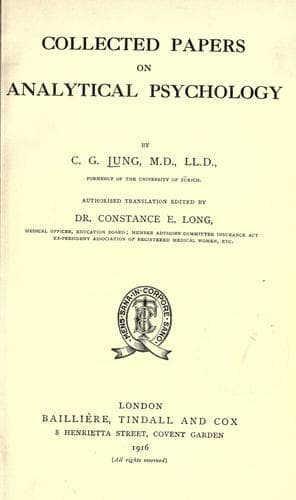
Collected Papers on Analytical PsychologyJung, C. G. (Carl Gustav)
Science
Collected Papers on Analytical Psychology
Jung, C. G. (Carl Gustav)
Psychoanalysis
Such a result is undoubtedly of scientific interest and worthy of
serious consideration. There is much in experimental psychology which
is of less use than the material exemplified in this test. Putting the
theoretical interest altogether aside, we have here something that is
not to be despised from a practical point of view, to wit, a culprit
has been brought to light in a much easier and shorter way than is
customary. What has been possible once or twice ought to be possible
again, and it is well worth while to investigate some means of rendering
the method increasingly capable of rapid and sure results.
This application of the experiment shows that it is possible to strike
a concealed, indeed an unconscious complex by means of a stimulus word;
and conversely we may assume with great certainty that behind a reaction
which shows a complex indicator there is a hidden complex, even though
the test-person strongly denies it. One must get rid of the idea that
educated and intelligent test-persons are able to see and admit their
own complexes. Every human mind contains much that is unacknowledged
and hence unconscious as such; and no one can boast that he stands
completely above his complexes. Those who persist in maintaining that
they can, are not aware of the spectacles upon their noses.
* * * * *
It has long been thought that the association experiment enables one
to distinguish certain _intellectual_ types. That is not the case. The
experiment does not give us any particular insight into the purely
intellectual, but rather into the emotional processes. To be sure we
can erect certain types of reaction; they are not, however, based on
intellectual peculiarities, but depend entirely on the _proportionate
emotional states_. Educated test-persons usually show superficial and
linguistically deep-rooted associations, whereas the uneducated form
more valuable associations and often of ingenious significance. This
behaviour would be paradoxical from an intellectual view-point. The
meaningful associations of the uneducated are not really the product of
intellectual thinking, but are simply the results of a special emotional
state. The whole thing is more important to the uneducated, his
emotion is greater, and for that reason he pays more attention to the
experiment than the educated person, and his associations are therefore
more significant. Apart from those determined by education, we have to
consider three principal individual types:
1. An objective type with undisturbed reactions.
2. A so-called complex-type with many disturbances in the experiment
occasioned by the constellation of a complex.
3. A so-called definition-type. The peculiarity of this type consists in
the fact that the reaction always gives an explanation or a definition
of the content of the stimulus word; _e.g._:
Public-domain text, read in full here on John Shaqi.
Reviews
Reviews
No reviews yet
Be the first to share your thoughts on this work.
Elsewhere in the archive
Join the Discussion
Join the discussion
Sign in to leave a comment or review.
Sign InorCreate an account