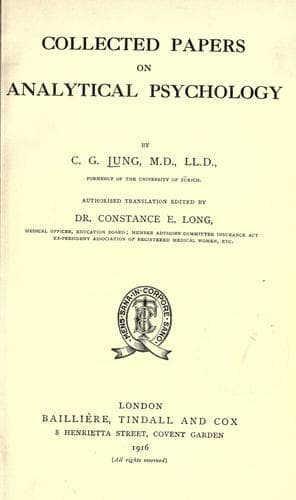
Collected Papers on Analytical PsychologyJung, C. G. (Carl Gustav)
Science
Collected Papers on Analytical Psychology
Jung, C. G. (Carl Gustav)
Psychoanalysis
apple,--a tree-fruit;
table,--a piece of household furniture;
to promenade,--an activity;
father,--chief of the family.
This type is chiefly found in stupid persons, and it is therefore quite
usual in imbecility. But it can also be found in persons who are not
really stupid, but who do not wish _to be taken as stupid_. Thus a young
student from whom associations were taken by an older intelligent woman
student reacted altogether with definitions. The test-person was of
the opinion that it was an examination in intelligence, and therefore
directed most of his attention to the significance of the stimulus
words; his associations, therefore, looked like those of an idiot. All
idiots, however, do not react with definitions; probably only those
react in this way who would like to appear smarter than they are, that
is, those to whom their stupidity is painful. I call this widespread
complex the "intelligence-complex." A normal test-person reacts in a
most overdrawn manner as follows:
anxiety--heart anguish;
to kiss--love's unfolding;
to kiss--perception of friendship.
This type gives a constrained and unnatural impression. The test-persons
wish to be more than they are, they wish to exert more influence than
they really have. Hence we see that persons with an intelligence-complex
are usually unnatural and constrained; that they are always somewhat
stilted, or flowery; they show a predilection for complicated foreign
words, high-sounding quotations, and other intellectual ornaments.
In this way they wish to influence their fellow-beings, they wish
to impress others with their apparent education and intelligence,
and thus to compensate for their painful feeling of stupidity. The
definition-type is closely related to the predicate-type, or, to express
it more precisely, to the predicate-type expressing personal judgment
(_Wertprädikattypus_). For example:
flower--pretty;
money--convenient;
animal--ugly;
knife--dangerous;
death--ghastly.
In the definition type the _intellectual_ significance of the stimulus
word is rendered prominent, but in the predicate type its _emotional_
significance. There are predicate-types which show great exaggeration
where reactions such as the following appear:
piano--horrible;
to sing--heavenly;
mother--ardently loved;
father--something good, nice, holy.
Public-domain text, read in full here on John Shaqi.
Reviews
Reviews
No reviews yet
Be the first to share your thoughts on this work.
Elsewhere in the archive
Join the Discussion
Join the discussion
Sign in to leave a comment or review.
Sign InorCreate an account