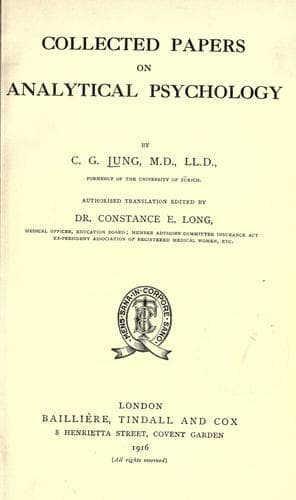
Collected Papers on Analytical PsychologyJung, C. G. (Carl Gustav)
Science
Collected Papers on Analytical Psychology
Jung, C. G. (Carl Gustav)
Psychoanalysis
This phenomenon has been designated as paradoxical and contrary to all
experience. For it is known that emotionally accentuated things are
better retained in memory than indifferent things. This is quite true,
but it does not hold for the _linguistic_ expression of an emotionally
accentuated content. On the contrary, one very easily forgets what he
has said under emotion, one is even apt to contradict himself about
it. Indeed, the efficacy of cross-examinations in court depends on
this fact. The reproduction method therefore serves to render still
more prominent the complex stimulus. In normal persons we usually find
a limited number of false reproductions, seldom more than 19-20 per
cent., while in abnormal persons, especially in hysterics, we often
find from 20-40 per cent. of false reproductions. The reproduction
certainty is therefore in certain cases a measure for the emotivity of
the test-person.
* * * * *
By far the larger number of neurotics show a pronounced tendency to
cover up their intimate affairs in impenetrable darkness, even from the
doctor, so that he finds it very difficult to form a proper picture
of the patient's psychology. In such cases I am greatly assisted by
the association experiment. When the experiment is finished, I first
look over the general course of the reaction times. I see a great many
very prolonged intervals; this means that the patient can only adjust
himself with difficulty, that his psychological functions proceed with
marked internal frictions with _resistances_. The greater number of
neurotics react only under great and very definite resistances; there
are, however, others in whom the average reaction times are as short as
in the normal, and in whom the other complex indicators are lacking,
but, despite that fact, they undoubtedly present neurotic symptoms.
These rare cases are especially found among very intelligent and
educated persons, chronic patients who, after many years of practice,
have learned to control their outward behaviour and therefore outwardly
display very little if any trace of their neuroses. The superficial
observer would take them for normal, yet in some places they show
disturbances which betray the repressed complex.
Public-domain text, read in full here on John Shaqi.
Reviews
Reviews
No reviews yet
Be the first to share your thoughts on this work.
Elsewhere in the archive
Join the Discussion
Join the discussion
Sign in to leave a comment or review.
Sign InorCreate an account