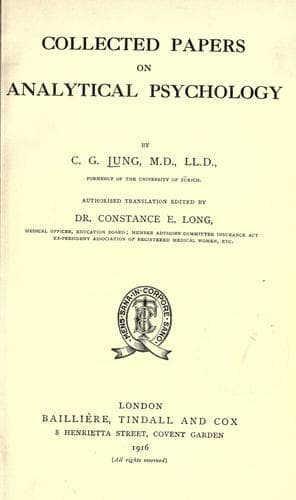
Collected Papers on Analytical PsychologyJung, C. G. (Carl Gustav)
Science
Collected Papers on Analytical Psychology
Jung, C. G. (Carl Gustav)
Psychoanalysis
In the definition-type an absolutely _intellectual_ make-up is
manifested or rather simulated, but here there is a very _emotional_
one. Yet, just as the definition-type really conceals a lack of
intelligence, so the excessive _emotional_ expression conceals or
overcompensates an emotional deficiency. This conclusion is very
interestingly illustrated by the following discovery:--On investigating
the influence of the familiar milieus on the association-type it was
found that young people seldom possess a predicate-type, but that, on
the other hand, the predicate-type increases in frequency with advancing
age. In women the increase of the predicate-type begins a little after
the 40th year, and in men after the 60th. That is the precise time when,
owing to the deficiency of sexuality, there actually occurs considerable
emotional loss. If a test-person evinces a distinct predicate-type, it
may always be inferred that a marked internal emotional deficiency is
thereby compensated. Still, one cannot reason conversely, namely, that
an inner emotional deficiency must produce a predicate-type, no more
than that idiocy directly produces a definition-type. A predicate-type
can also betray itself through the external behaviour, as, for example,
through a particular affectation, enthusiastic exclamations, an
embellished behaviour, and the constrained sounding language so often
observed in society.
The complex-type shows no particular tendency except the _concealment_
of a complex, whereas the definition and predicate types betray a
positive tendency to exert in some way a _definite_ influence on the
experimenter. But whereas the definition-type tends to bring to light
its intelligence, the predicate-type displays its emotion. I need hardly
add of what importance such determinations are for the diagnosis of
character.
After finishing an association experiment I usually add another of a
different kind, the so-called _reproduction_ experiment. I repeat the
same stimulus words and ask the test-persons whether they still remember
their former reactions. In many instances the memory fails, and as
experience shows, these locations are stimulus words which touched an
emotionally accentuated complex, or stimulus words immediately following
such critical words.
Public-domain text, read in full here on John Shaqi.
Reviews
Reviews
No reviews yet
Be the first to share your thoughts on this work.
Elsewhere in the archive
Join the Discussion
Join the discussion
Sign in to leave a comment or review.
Sign InorCreate an account