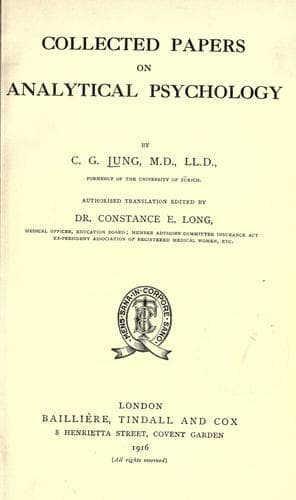
Collected Papers on Analytical PsychologyJung, C. G. (Carl Gustav)
Science
Collected Papers on Analytical Psychology
Jung, C. G. (Carl Gustav)
Psychoanalysis
The mother is 45 years old and the daughter 16 years. Both have a very
distinct predicate-type expressing personal judgment, both differ from
the father in the most striking manner. The father is a drunkard and
a demoralised creature. We can thus readily understand that his wife
experiences an emotional voidness which she naturally betrays by her
enhanced predicate-type. The same causes cannot, however, operate in
the case of the daughter, for, in the first place, she is not married
to a drunkard, and, in the second, life with all its hopes and promises
still lies before her. It is distinctly unnatural for the daughter
to show an extreme predicate-type expressing personal judgment. She
responds to the stimuli of the environment just like her mother. But
whereas in the mother the type is in a way a natural consequence of her
unhappy condition of life, this condition is entirely lacking in the
daughter. The daughter simply imitates the mother; she merely appears
like the mother. Let us consider what this can signify for a young girl.
If a young girl reacts to the world like an old woman, disappointed
in life, this at once shows unnaturalness and constraint. But more
serious consequences are possible. As you know the predicate-type is a
manifestation of intensive emotions; the emotions are always involved.
Thus we cannot prevent ourselves from responding inwardly, at least,
to the feelings and passions of our immediate environment; we allow
ourselves to be infected and carried away by it. Originally the effects
and their physical manifestations had a biological significance; _i.e._
they were a protective mechanism for the individual and the whole
herd. If we manifest emotions, we can with certainty expect to receive
emotions in return. That is the feeling of the predicate-type. What the
45-year-old woman lacks in emotions, _i.e._ in love in her marriage
relations she seeks to obtain in the outside world, and for that reason
she is an ardent participant in the Christian Science movement. If
the daughter imitates this situation she copies her mother, she seeks
to obtain emotions from the outside. But for a girl of sixteen such
an emotional state is, to say the least, quite dangerous; like her
mother, she reacts to her environment as a sufferer soliciting sympathy.
Such an emotional state is no longer dangerous in the mother, but for
obvious reasons it is quite dangerous in the daughter. Once freed from
her father and mother she will be like her mother, _i.e._ she will be
a suffering woman craving for inner gratification. She will thus be
exposed to the great danger of falling a victim to brutality and of
marrying a brute and inebriate like her father.
Public-domain text, read in full here on John Shaqi.
Reviews
Reviews
No reviews yet
Be the first to share your thoughts on this work.
Elsewhere in the archive
Join the Discussion
Join the discussion
Sign in to leave a comment or review.
Sign InorCreate an account