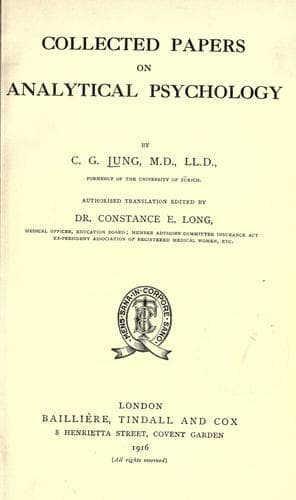
Collected Papers on Analytical PsychologyJung, C. G. (Carl Gustav)
Science
Collected Papers on Analytical Psychology
Jung, C. G. (Carl Gustav)
Psychoanalysis
This conception is of importance in the consideration of the influence
of environment and education. The example shows what passes over from
the mother to the child. It is not the good and pious precepts, nor
is it any other inculcation of pedagogic truths that have a moulding
influence upon the character of the developing child, but what most
influences him is the peculiarly affective state which is totally
unknown to his parents and educators. The concealed discord between
the parents, the secret worry, the repressed hidden wishes, all these
produce in the individual a certain affective state with its objective
signs which slowly but surely, though unconsciously, works its way
into the child's mind, producing therein the same conditions and hence
the same reactions to external stimuli. We know the depressing effect
mournful and melancholic persons have upon us. A restless and nervous
individual infects his surroundings with unrest and dissatisfaction,
a grumbler with his discontent, etc. Since grown-up persons are so
sensitive to surrounding influences, we should certainly expect this
to be even more noticeable among children, whose minds are as soft and
plastic as wax. The father and mother impress deeply into the child's
mind the seal of their personality; the more sensitive and mouldable the
child the deeper is the impression. Thus things that are never even
spoken about are reflected in the child. The child imitates the gesture,
and just as the gesture of the parent is the expression of an emotional
state, so in turn the gesture gradually produces in the child a similar
feeling, as it feels itself, so to speak, into the gesture. Just as the
parents adapt themselves to the world, so does the child. At the age
of puberty when it begins to free itself from the spell of the family,
it enters into life with, so to say, a surface adaptation entirely in
keeping with that of the father and mother. The frequent and often very
deep _depressions of puberty_ emanate from this; they are symptoms which
are rooted in the difficulty of new adjustment. The youthful person at
first tries to separate himself as much as possible from his family; he
may even estrange himself from it, but inwardly this only ties him the
more firmly to the parental image. I cite the case of a young neurotic
who ran away from his parents; he was estranged from, and almost hostile
to them, but he admitted to me that he possessed a special sanctum; it
was a strong box containing his old childhood books, old dried flowers,
stones, and even small bottles of water from the well at his home and
from a river along which he walked with his parents, etc.
Public-domain text, read in full here on John Shaqi.
Reviews
Reviews
No reviews yet
Be the first to share your thoughts on this work.
Elsewhere in the archive
Join the Discussion
Join the discussion
Sign in to leave a comment or review.
Sign InorCreate an account