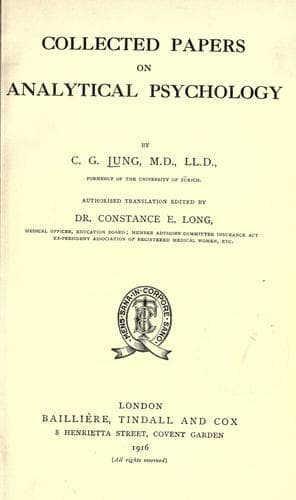
Collected Papers on Analytical PsychologyJung, C. G. (Carl Gustav)
Science
Collected Papers on Analytical Psychology
Jung, C. G. (Carl Gustav)
Psychoanalysis
lady, who did not pass carelessly over her mental experiences, who
indeed reflected much over her unhappiness, without, however, having any
idea whence her misfortune originated.
There are things which unconsciously appear to us as a matter of course,
and it is for this reason that we do not see them truly, but attribute
everything to the so-called congenital character. I could cite any
number of examples of this kind. Every patient furnishes contributions
to this subject of the determination of destiny through the influence of
the familiar milieu. In every neurotic we see how the constellation of
the infantile milieu influences not only the character of the neurosis,
but also life's destiny, even in its minute details. The unhappy choice
of a profession, and innumerable matrimonial failures can be traced
to this constellation. There are, however, cases where the profession
has been well chosen, where the husband or wife leaves nothing to
be desired, and where still the person does not feel well but works
and lives under constant difficulties. Such cases often appear under
the guise of chronic neurasthenia. Here the difficulty is due to the
fact that the mind is unconsciously split into two parts of divergent
tendencies which are impeding each other; one part lives with the
husband or with the profession, while the other lives unconsciously in
the past with the father or mother. I have treated a lady who, after
suffering many years from a severe neurosis, merged into a dementia
præcox. The neurotic affection began with her marriage. This lady's
husband was kind, educated, well to do, and in every respect suitable
for her; his character showed nothing that would in any way interfere
with a happy marriage. The marriage was nevertheless unhappy, all
congenial companionship being excluded because the wife was neurotic.
The important heuristic axiom of every psychoanalysis reads as
follows: _If a person develops a neurosis this neurosis contains the
counter-argument against the relation of the patient to the individual
with whom he is most intimately connected._ A neurosis in the husband
loudly proclaims that he has intensive resistances and contrary
tendencies against his wife; if the wife has a neurosis she has a
tendency which diverges from her husband. If the person is unmarried
the neurosis is then directed against the lover or the sweetheart or
against the parents. Every neurotic naturally strives against this
relentless formulation of the content of his neurosis, and he often
refuses to recognise it at any cost, but still it is always justified.
To be sure, the conflict is not on the surface, but must generally be
revealed through a painstaking psychoanalysis.
The history of our patient reads as follows:
Public-domain text, read in full here on John Shaqi.
Reviews
Reviews
No reviews yet
Be the first to share your thoughts on this work.
Elsewhere in the archive
Join the Discussion
Join the discussion
Sign in to leave a comment or review.
Sign InorCreate an account