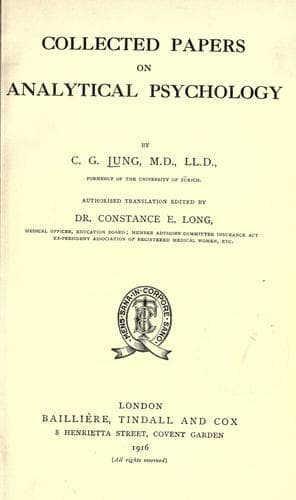
Collected Papers on Analytical PsychologyJung, C. G. (Carl Gustav)
Science
Collected Papers on Analytical Psychology
Jung, C. G. (Carl Gustav)
Psychoanalysis
The father had a powerful personality. She was his favourite daughter,
and entertained for him a boundless veneration. At the age of seventeen
she for the first time fell in love with a young man. At that time she
twice dreamt the same dream, the impression of which never left her in
all her later years; she even imputed a mystic significance to it, and
often recalled it with religious dread. In the dream she saw a tall,
masculine figure with a very beautiful white beard; at this sight she
was permeated with a feeling of awe and delight as if she experienced
the presence of God Himself. This dream made the deepest impression
on her, and she was constrained to think of it again and again. The
love affair of that period proved to be one of little warmth, and was
soon given up. Later the patient married her present husband. Though
she loved her husband she was led continually to compare him with her
deceased father; this comparison always proved unfavourable to her
husband. Whatever the husband said, intended, or did, was subjected
to this standard and always with the same result: "My father would
have done all this better and differently." Our patient's life with
her husband was not happy, she could neither respect nor love him
sufficiently; she was inwardly dissatisfied. She gradually developed
a fervent piety, and at the same time violent hysterical symptoms
supervened. She began by going into raptures now over this and now over
that clergyman; she was looking everywhere for a spiritual friend, and
estranged herself more and more from her husband. The mental trouble
manifested itself about ten years after marriage. In her diseased state
she refused to have anything to do with her husband and child; she
imagined herself pregnant by another man. In brief, the resistances
against her husband, which hitherto had been laboriously repressed,
came out quite openly, and among other things manifested themselves in
insults of the gravest kind directed against him.
In this case we see how a neurosis appeared, as it were, at the moment
of marriage, _i.e. this neurosis expresses the counter-argument against
the husband_. What is the counter-argument? The counter-argument is
the father of the patient, for she verified her belief daily that her
husband was not the equal of her father. When the patient first fell in
love there had appeared a symptom in the form of an extremely impressive
dream or vision. She saw the man with the very beautiful white beard.
Who was this man? On directing her attention to the beautiful white
beard she immediately recognised the phantom. It was of course her
father. Thus every time the patient merged into a love affair the
picture of her father inopportunely appeared and prevented her from
adjusting herself psychologically to her husband.
Public-domain text, read in full here on John Shaqi.
Reviews
Reviews
No reviews yet
Be the first to share your thoughts on this work.
Elsewhere in the archive
Join the Discussion
Join the discussion
Sign in to leave a comment or review.
Sign InorCreate an account