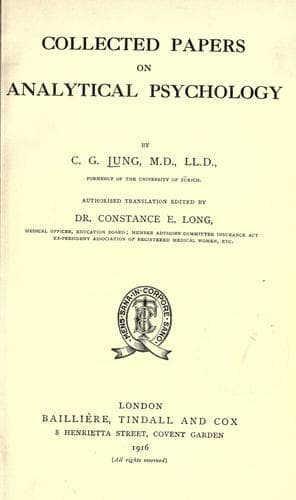
Collected Papers on Analytical PsychologyJung, C. G. (Carl Gustav)
Science
Collected Papers on Analytical Psychology
Jung, C. G. (Carl Gustav)
Psychoanalysis
S. W. shows primary susceptibility of the unconscious--Binet
affirms the susceptibility of the hysteric is fifty times
greater than that of normal--Cryptomnesia, a second additional
creation--Cryptomnesic picture may enter consciousness
intra-physically--Unconscious plagiarism explained--Zarathustra
example--Glossolalia--Helen Smith's Martian language--The names
in Ivenes' mystic system show rudimentary glossolalia--The
Cryptomnesic picture may enter consciousness as a hallucination--Or
arrive at consciousness by motor automatism--By automatisms regions
formerly sealed are made accessible--Hypermnesia--Thought-reading
a prototype for extraordinary intuitive knowledge of somnambulists
and some normal persons--Association-concordance--Possibility
that concept and feeling are not always clearly separated in the
unconscious--S. W.'s mentality must be regarded as extraordinary.
CHAPTER II
THE ASSOCIATION METHOD 94
LECTURE I.--Formula for test--Disturbances of reaction
as complex-indicators--Discovery of a culprit by means of
test--Disturbances of reaction show emotional rather than
intellectual causes--Principal types--Value of the experiment in
dealing with neurotics.
LECTURE II.--FAMILIAR CONSTELLATIONS 119
Dr. Fürst's researches--Effect of environment and education
on reactions--Effect of parental discord on children--Unconscious
tendency to repetition of parental mistakes--Case of pathological
association-concordance between mother and daughter--Neurosis, a
counter-argument against the personality with which the patient is
most nearly concerned--How to free the individual from unconscious
attachments to the milieu.
LECTURE III.--EXPERIENCES CONCERNING THE PSYCHIC LIFE OF
THE CHILD 132
Importance of emotional processes in children--Little Anna's
questions--Arrival of the baby brother--Anna's embarrassment and
hostility--Introversion of the child--Of the adolescent--Her
pathological interest in the Messina earthquake--The meaning of
her fear--Anna's theories of birth--Meaning of her questions--Her
father tells her something of origin of her little brother--Her
fears now subside--The unconscious meaning of the child's wish to
sit up late--Anna's equivalent to the "lumpf-theory" of little
Hans--The stork-theory again--Author's remarks on the sexual
enlightenment of the child.
CHAPTER III
THE SIGNIFICANCE OF THE FATHER IN THE DESTINY OF THE
INDIVIDUAL 156
Public-domain text, read in full here on John Shaqi.
Reviews
Reviews
No reviews yet
Be the first to share your thoughts on this work.
Join the Discussion
Join the discussion
Sign in to leave a comment or review.
Sign InorCreate an account