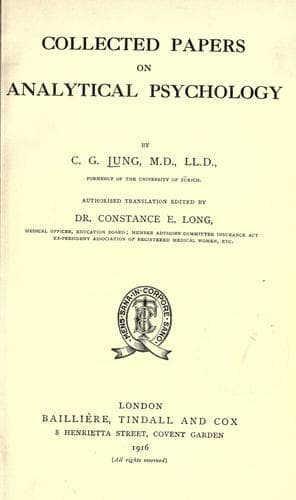
Collected Papers on Analytical PsychologyJung, C. G. (Carl Gustav)
Science
Collected Papers on Analytical Psychology
Jung, C. G. (Carl Gustav)
Psychoanalysis
Just as the birth of a little sister was the turning point in the
history of "Little Hans," so in this case it was the birth of a
brother, which happened when Anna had reached the age of four years.
The pregnancy of the mother apparently remained unnoticed; _i.e._ the
child never expressed herself on this subject. On the evening before the
birth, when labour pains were beginning, the child was in her father's
room. He took her on his knee and said, "Tell me, what would you say
if you should get a little brother to-night?" "I would kill him" was
the prompt answer. The expression "to kill" looks very serious, but
in reality it is quite harmless, for "to kill" and "to die" in child
language signify only to remove, either in the active or in the passive
sense, as has already been pointed out a number of times by Freud.
"To kill" as used by the child is a harmless word, especially so when
we know that the child uses the word "kill" quite promiscuously for
all possible kinds of destruction, removal, demolition, etc. It is,
nevertheless, worth while to note this tendency (see the analysis of
_Kleiner Hans_, p. 5).
The birth occurred early in the morning, and later the father entered
the room where Anna slept. She awoke as he came in. He imparted to her
the news of the advent of a little brother, which she took with surprise
and strained facial expression. The father took her in his arms and
carried her into the lying-in room. She first threw a rapid glance at
her somewhat pale mother and then displayed something like a mixture of
embarrassment and suspicion as if thinking, "Now what else is going to
happen?" (Father's impression.) She displayed hardly any pleasure at the
sight of the new arrival, so that the cool reception she gave it caused
general disappointment. During the forenoon she kept very noticeably
away from her mother; this was the more striking as she was usually
much attached to her. But once when her mother was alone she ran into
the room, embraced her and said, "Well, aren't you going to die now?"
Now a part of the conflict in the child's psyche is revealed to us.
Though the stork theory was never really taken seriously, she accepted
the fruitful re-birth hypothesis, according to which a person by dying
helps a child into life. Accordingly the mother, too, must die; why,
then, should the newborn child, against whom she already felt childish
jealousy, cause her pleasure? It was for this reason that she had to
seek a favourable opportunity of reassuring herself as to whether the
mother was to die, or rather was moved to express the hope that she
would not die.
Public-domain text, read in full here on John Shaqi.
Reviews
Reviews
No reviews yet
Be the first to share your thoughts on this work.
Elsewhere in the archive
Join the Discussion
Join the discussion
Sign in to leave a comment or review.
Sign InorCreate an account