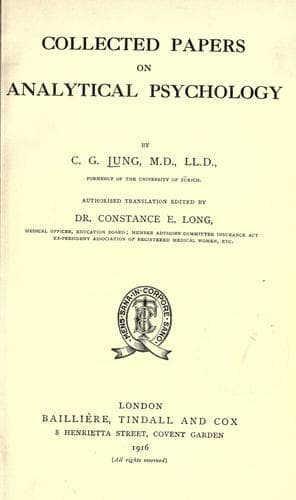
Collected Papers on Analytical PsychologyJung, C. G. (Carl Gustav)
Science
Collected Papers on Analytical Psychology
Jung, C. G. (Carl Gustav)
Psychoanalysis
With this happy issue, however, the re-birth theory sustained a severe
shock. How was it possible now to explain the birth of her little
brother and the origin of children in general? There still remained the
stork theory which, though never expressly rejected, had been implicitly
waived through the assumption of the re-birth theory. The explanations
next attempted unfortunately remained hidden from the parents as the
child went to stay with her grandmother for a few weeks. From the
latter's report the stork theory was often discussed, and was naturally
reinforced by the concurrence of those about her.
When Anna returned to her parents, she again, on meeting her mother,
evinced the same mixture of embarrassment and suspicion which she had
displayed after the birth. The impression, though inexplicable, was
quite unmistakable to both parents. Her behaviour towards the baby was
very nice. During her absence a nurse had come into the house who, on
account of her uniform, made a deep impression on Anna; to be sure, the
impression at first was quite unfavourable as she evinced the greatest
hostility to her. Thus nothing could induce her to allow herself to
be undressed and put to sleep by this nurse. Whence this resistance
originated was soon shown in an angry scene near the cradle of the
little brother in which Anna shouted at the nurse, "This is not your
little brother, he is mine!" Gradually, however, she became reconciled
to the nurse, and began to play nurse herself; she had to have her white
cap and apron, and "nursed" now her little brother, and now her doll.
In contrast to her former mood she became unmistakably mournful and
dreamy. She often sat for a long time under the table singing stories
and making rhymes, which were partially incomprehensible but sometimes
contained the "nurse" theme ("I am a nurse of the green cross"). Some of
the stories, however, distinctly showed a painful feeling striving for
expression.
Public-domain text, read in full here on John Shaqi.
Reviews
Reviews
No reviews yet
Be the first to share your thoughts on this work.
Elsewhere in the archive
Join the Discussion
Join the discussion
Sign in to leave a comment or review.
Sign InorCreate an account