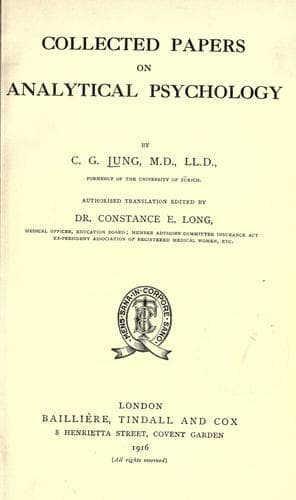
Collected Papers on Analytical PsychologyJung, C. G. (Carl Gustav)
Science
Collected Papers on Analytical Psychology
Jung, C. G. (Carl Gustav)
Psychoanalysis
readily explains her suspicion at the childbirth and her discrediting
of her mother. But it also explains another point, namely, the elegiac
reveries which we have attributed to a partial introversion. We know
now what was the real object from which love was removed and uselessly
introverted, namely, it had to be taken _from the parents_ who deceived
her and refused to tell her the truth. (What can this be which must not
be uttered? What is going on here?) Such were the parenthetic questions
of the child, and the answer was: Evidently this must be something to
be concealed, perhaps something dangerous. Attempts to make her talk
and to draw out the truth by means of artful questions were futile,
so _resistance is placed against resistance_, and the introversion
of love begins. It is evident that the capacity for sublimation in a
four-year-old child is still too slightly developed to be capable of
performing more than symptomatic services. The mind, therefore, depends
on another compensation, namely, it resorts to one of the relinquished
infantile devices for securing love by force, preferably that of crying
and calling the mother at night. This had been diligently practised
and exhausted during her first year. It now returns, and corresponding
to the period of life has become well determined and equipped with
recent impressions. It was just after the earthquakes in Messina, and
this event was discussed at the table. Anna was extremely interested
in everything, she repeatedly asked her grandmother to tell her how
the earth shook, how the houses fell in and many people lost their
lives. After this she had nocturnal fears, she could not be alone, her
mother had to go to her and stay with her; otherwise she feared that an
earthquake would happen, that the house would fall and kill her. During
the day, too, she was much occupied with such thoughts. While walking
with her mother she annoyed her with such questions as, "Will the house
be standing when we return home? Are you sure there is no earthquake at
home? Will papa still be living?" About every stone lying in the road
she asked whether it was from an earthquake. A building in course of
erection was a house destroyed by the earthquake, etc. Finally, she
began to cry out frequently at night that the earthquake was coming and
that she heard the thunder. Each evening she had to be solemnly assured
that there was no earthquake coming.
Public-domain text, read in full here on John Shaqi.
Reviews
Reviews
No reviews yet
Be the first to share your thoughts on this work.
Elsewhere in the archive
Join the Discussion
Join the discussion
Sign in to leave a comment or review.
Sign InorCreate an account