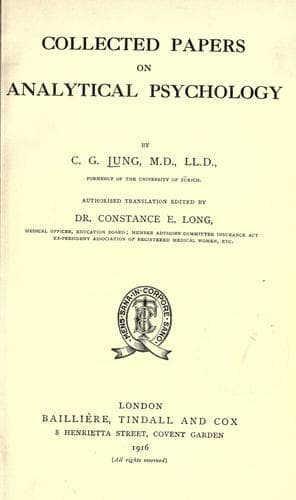
Collected Papers on Analytical PsychologyJung, C. G. (Carl Gustav)
Science
Collected Papers on Analytical Psychology
Jung, C. G. (Carl Gustav)
Psychoanalysis
Scenes of this kind were repeated a number of times. This time the
tone was more rude and more vehement, and at the same time the accent
on the word "lie" betrayed something special which the parents did not
understand; indeed, at first they attributed too little significance to
the spontaneous utterances of the child. In this they merely did what
education usually does in general, _ex officio_. We usually pay little
heed to children in every stage of life; in all essential matters, they
are treated as not responsible, and in all unessential matters, they are
trained with an automatic precision.
Under resistances there always lies a question, a conflict, of which we
hear later and on other occasions. But usually one forgets to connect
the thing heard with the resistances. Thus, on another occasion, Anna
put to her mother the following questions:--
Anna: "I should like to become a nurse when I grow big--why did you not
become a nurse?"
Mother: "Why, as I have become a mother I have children to nurse anyway."
A. (Reflecting): "Indeed, shall I be a lady like you, and shall I talk
to you then?"
The mother's answer again shows whither the child's question was really
directed. Apparently Anna, too, would like to have a child to "nurse"
just as the nurse has. Where the nurse got the little child is quite
clear. Anna, too, could get a child in the same way if she were big.
Why did not the mother become such a nurse, that is to say, how did
she get a child if not in the same way as the nurse? Like the nurse,
Anna, too, could get a child, but how that fact might be changed in
the future or how she might come to resemble her mother in the matter
of getting children is not clear to her. From this resulted the
thoughtful question, "Indeed, shall I be a lady like you? Shall I be
quite different?" The stork theory evidently had come to naught, the
dying theory met a similar fate; hence she now thinks one may get a
child in the same way, as, for example, the nurse got hers. She, too,
could get one in this natural way, but how about the mother who is no
nurse and still has children? Looking at the matter from this point of
view, Anna asks: "Why did you not become a nurse?" namely, "why have
you not got your child in the natural way?" This peculiar indirect
manner of questioning is typical, and evidently corresponds with the
child's hazy grasp of the problem, unless we assume a certain diplomatic
uncertainty prompted by a desire to evade direct questioning. We shall
later find an illustration of this possibility. Anna is evidently
confronted with the question "Where does the child come from?" The
stork did not bring it; mother did not die; nor did mother get it in
the same way as the nurse. She has, however, asked this question before
and received the information from her father that the stork brings
children; this is positively untrue, she can never be deceived on
this point. Accordingly, papa and mama and all the others lie. This
Public-domain text, read in full here on John Shaqi.
Reviews
Reviews
No reviews yet
Be the first to share your thoughts on this work.
Elsewhere in the archive
Join the Discussion
Join the discussion
Sign in to leave a comment or review.
Sign InorCreate an account