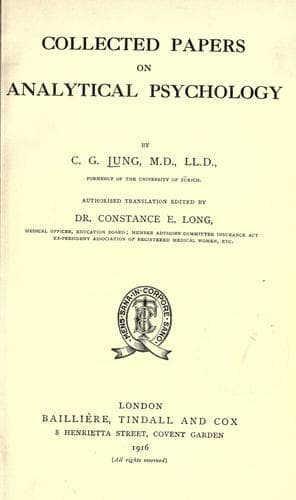
Collected Papers on Analytical PsychologyJung, C. G. (Carl Gustav)
Science
Collected Papers on Analytical Psychology
Jung, C. G. (Carl Gustav)
Psychoanalysis
A few weeks then passed without any noteworthy occurrences. On one
occasion she related the following dream: "_I dreamed about papa and
mama; they had been sitting late in the study, and we children were
there too._" On the face of this we find a wish of the children to be
allowed to sit up as long as the parents. This wish is here realised,
or rather it is utilised to express a more important wish, namely, _to
be present in the evening when the parents are alone_; of course, quite
innocently, it was in the _study_ where she has seen all the interesting
books, and where she has satiated her thirst for knowledge; _i.e._ she
was really seeking an answer to the burning question, whence the little
brother came. If the children were there they would find out.[145] A
few days later Anna had a terrifying dream from which she awoke crying,
"The earthquake is coming, the house has begun to shake." Her mother
went to her and calmed her by saying that the earthquake was not coming,
that everything was quiet, and that everybody was asleep. Whereupon Anna
said: "_I would like to see the spring, when all the little flowers are
coming out and the whole lawn is full of flowers; I would like to see
Freddy, he has such a dear little face. What is papa doing? What is he
saying?_" The mother said, "He is asleep, and isn't saying anything
now." Little Anna then remarked with a sarcastic smile: "_He will surely
be sick again to-morrow._"
This text should be read backwards. The last sentence was not meant
seriously, as it was uttered in a mocking tone. When the father was sick
the last time, Anna suspected that he had a "plant in his inside." The
sarcasm signifies: "To-morrow papa is surely going to have a child." But
this also is not meant seriously. Papa is not going to have a child;
mama alone has children; perhaps she will have another child to-morrow;
but where from? "What does papa do?" The formulation of the difficult
problem seems here to come to the surface. It reads: What does papa
really do if he does not bear children? The little one is very anxious
to have a solution for all these problems; she would like to know how
Freddy came into the world, she would like to see how the little flowers
come out of the earth in the spring, and these wishes are hidden behind
the fear of earthquakes.
After this intermezzo Anna slept quietly until morning. In the morning
her mother asked her what she had dreamed. She did not at first recall
anything, and then said: "_I dreamed that I could make the summer, and
then some one threw a Punch_[146] _down into the closet._"
Public-domain text, read in full here on John Shaqi.
Reviews
Reviews
No reviews yet
Be the first to share your thoughts on this work.
Elsewhere in the archive
Join the Discussion
Join the discussion
Sign in to leave a comment or review.
Sign InorCreate an account