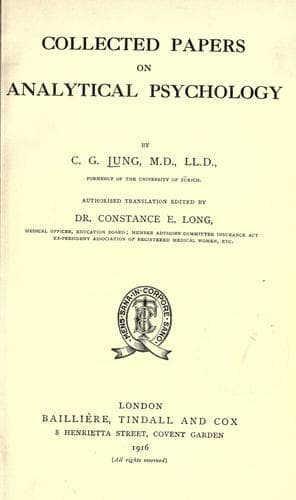
Collected Papers on Analytical PsychologyJung, C. G. (Carl Gustav)
Science
Collected Papers on Analytical Psychology
Jung, C. G. (Carl Gustav)
Psychoanalysis
This peculiar dream apparently has two different scenes which are
separated by "then." The second part draws its material from the recent
wish to possess a Punch, that is, to have a boy doll just as mama has
a little boy. Some one threw Punch down into the closet; one often
lets other things fall down into the water closet. _It is just like
this that the children, too, come out._ We have here an analogy to the
"Lumpf-theory" of little Hans.[147] Whenever several scenes are found
in one dream, each scene ordinarily represents a particular variation
of the complex elaboration. Here accordingly the first part is only a
variation of the theme found in the second part. The meaning of "to see
the spring" or "to see the little flowers come out" we have already
remarked. Anna now dreams that she _can make the summer_, that is she
can bring it about that the little flowers shall come out. She herself
can make a little child, and the second part of the dream represents
this just as one makes a motion in the w.c. Here we find the egoistic
wish which is behind the seemingly objective interest of the previous
night's conversation.
A few days later the mother was visited by a lady who expected soon to
become a mother. The children seemed to take no interest in the matter,
but the next day they amused themselves with the following play which
was directed by the elder girl; they took all the newspapers they
could find in their father's paper-basket and stuffed them under their
clothes, so that the imitation was unmistakable. During the night little
Anna had another dream: "_I dreamed about a woman in the city; she had
a very big stomach._" The chief actor in a dream is always the dreamer
himself under some definite aspect; thus the childish play of the day
before is fully solved.
Not long after, Anna surprised her mother with the following
performance: She stuck her doll under her clothes, then pulled it out
slowly head downwards, and at the same time remarked, "_Look, the baby
is coming out, now it is all out._" By this means Anna tells her mother,
"You see, thus I apprehend the problem of birth. What do you think of
it? Is that right?" The play is really meant to be a question, for,
as we shall see later, this idea had to be officially confirmed. That
rumination on this problem by no means ended here, is shown by the
occasional ideas conceived during the following weeks. Thus she repeated
the same play a few days later with her Teddy Bear, who stands in the
relation of an especially beloved doll. One day, looking at a rose,
she said to her grandmother, "See, the rose is getting a baby." As her
grandmother did not quite understand her, she pointed to the enlarged
calyx and said, "Don't you see it is quite fat here?"
Public-domain text, read in full here on John Shaqi.
Reviews
Reviews
No reviews yet
Be the first to share your thoughts on this work.
Elsewhere in the archive
Join the Discussion
Join the discussion
Sign in to leave a comment or review.
Sign InorCreate an account