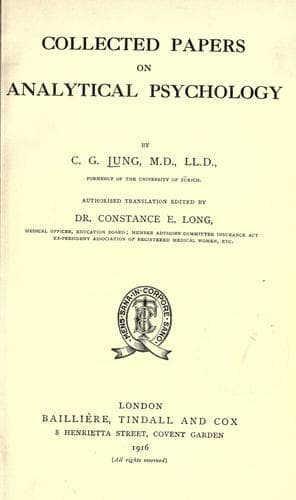
Collected Papers on Analytical PsychologyJung, C. G. (Carl Gustav)
Science
Collected Papers on Analytical Psychology
Jung, C. G. (Carl Gustav)
Psychoanalysis
With this last performance the problem seemed to be at rest entirely,
at least the parents found no opportunity to make any pertinent
observations. That the problem should come to a standstill just here
is not at all surprising, for this is really its most difficult part.
Moreover, we know from experience that not many children go beyond
these limits during the period of childhood. The problem is almost
too difficult for the childish mind, which still lacks much knowledge
necessary to its solution.
This standstill lasted about five months, during which no phobias or
other signs of complex-elaboration appeared. After this lapse of time
there appeared premonitory signs of some new incidents. Anna's family
lived at that time in the country near a lake where the mother and
children could bathe. As Anna was afraid to wade farther into the water
than knee-deep, her father once put her into the water, which led to
an outburst of crying. In the evening while going to bed Anna asked
her mother, "Do you not believe that father wanted to drown me?" A few
days later there was another outburst of crying. She continued to stand
in the gardener's way until he finally placed her in a newly dug hole.
Anna cried bitterly, and afterwards maintained that the gardener wished
to bury her. Finally she awoke during the night with fearful crying.
Her mother went to her in the adjoining room and quieted her. She had
dreamed that "a train passed and then fell in a heap."
This tallies with the "stage coach" of "little Hans." These incidents
showed clearly enough that fear was again in the air, _i.e._ that a
resistance had again arisen preventing transference to the parents,
and that therefore a great part of her love was converted into fear.
This time suspicion was not directed against the mother, but against
the father, who she was sure must know the secret, but would never
let anything out. What could the father be doing or keeping secret?
To the child this secret appeared as something dangerous, so that she
felt the worst might be expected from the father. (This feeling of
childish anxiety with the father as object we see again most distinctly
in adults, especially in dementia præcox, which lifts the veil of
obscurity from many unconscious processes, as though it were following
psychoanalytic principles.) It was for this reason that Anna came to
the apparently absurd conclusion that her father wanted to drown her.
At the same time her fear contained the thought that the _object of the
father had some relation to a dangerous action_. This stream of thought
is no arbitrary interpretation. Anna meanwhile grew a little older and
her interest in her father took on a special colouring which is hard to
describe. Language has no words to describe the quite unique kind of
tender curiosity which shone in the child's eyes.
Public-domain text, read in full here on John Shaqi.
Reviews
Reviews
No reviews yet
Be the first to share your thoughts on this work.
Elsewhere in the archive
Join the Discussion
Join the discussion
Sign in to leave a comment or review.
Sign InorCreate an account